Where the Sea Speaks Louder Than Words: Batticaloa Lighthouse

Where the Sea Speaks Louder Than Words: Batticaloa Lighthouse

I almost missed it entirely, which would have been a shame. The lighthouse does not announce itself from the main road, and there are no signs urging you to pull over and take a photograph. You find it the way you find most worthwhile things in Sri Lanka, by wandering slightly off the obvious path and paying attention.

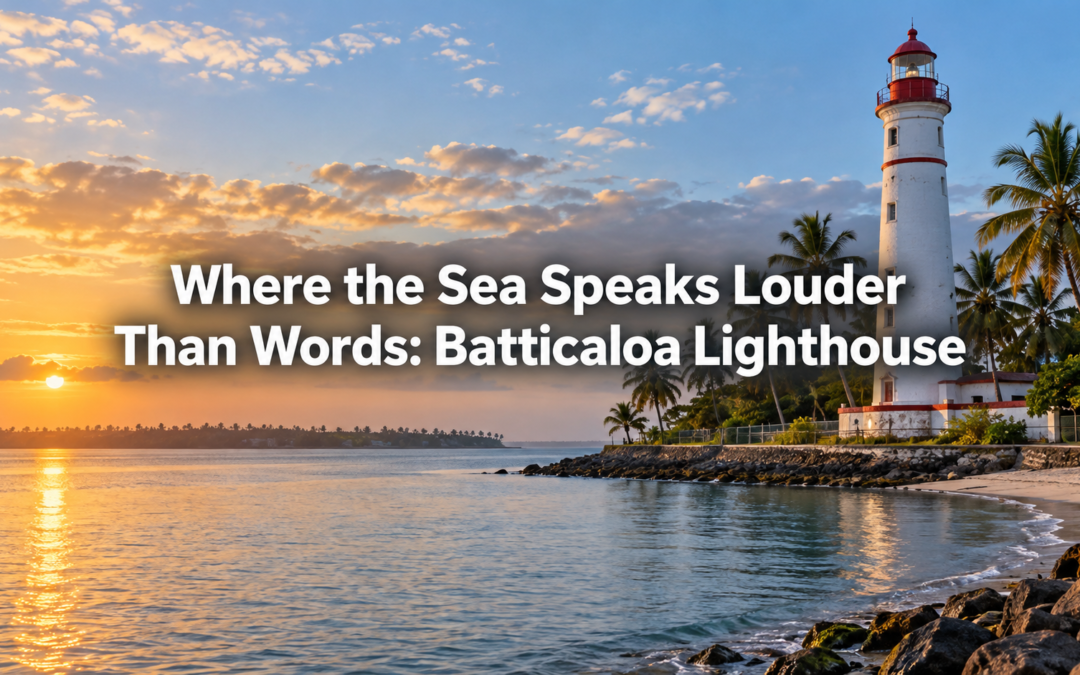
It arrived unannounced, tucked between a stretch of beach road and the great blue expanse that seems, from here, to go on forever. No grand entrance. No ticket booth. Just a tall white tower rising from the flat coastal earth, its painted bands catching the afternoon light, and below it, that sea.

A Lighthouse With a Story Worth Telling

The Batticaloa Lighthouse has been standing on Sri Lanka’s east coast long enough to have watched the country through a great deal of its modern history. Built by the British in the 19th century, it sits on the southern end of Batticaloa town, near the mouth of the lagoon where the calm backwaters meet the open sea. It is not the tallest lighthouse on the island, nor the most photogenic in the conventional sense. But there is something about it that makes you want to stay longer than you planned.

The structure itself is white and red, cylindrical, with a lantern room at the top that has guided fishing boats and cargo vessels through these waters for generations. Around the base, the grounds are pleasantly unhurried. Fishing nets dry in the sun nearby. Stray cats regard you with the mild interest they reserve for people who might have food. It is, in the most wonderful way, completely unpretentious.

What strikes me most is not the lighthouse itself but the layers of life surrounding it. Batticaloa is a town with a Tamil and Muslim majority, a place that carries its history visibly, in its architecture, its food, its rhythms. The lighthouse sits within that context rather than apart from it, a colonial remnant that has been quietly absorbed into the daily life of a community that has seen far more than most.

What to See and Do

The lighthouse grounds are a fine place to simply exist for an hour. Walk the perimeter, watch the fishing boats come in across the lagoon, and let the breeze do what it likes with your hair. Early morning and late afternoon are both rewarding, though for different reasons: morning brings the fishermen returning with their catch and a soft, golden light that is very kind to photographs; late afternoon turns everything amber and the sea takes on the look of hammered copper.

From here it is an easy walk or tuk-tuk ride to the famous Batticaloa Fort, a Dutch-built stronghold that now houses government offices but remains open to curious visitors. The fort is compact and atmospheric, its walls weathered to a beautiful grey, with views over the lagoon from the ramparts. Pair the two in a single afternoon and you have yourself a proper introduction to Batticaloa’s layered past.

The Kallady Bridge is another worthwhile stop, not far away. It is an old Dutch bridge, one of the longest in Sri Lanka, and walking across it at dusk is one of those low-effort, high-reward travel experiences that you quietly file away and bring up later when people ask you about your trip. The lagoon on either side glows in the fading light, and the bridge itself hums gently with motorcycles and pedestrians going about their evening.

Batticaloa is also known, somewhat mysteriously, for its singing fish. Local legend holds that musical sounds rise from the lagoon on full moon nights, and while I cannot personally confirm or deny the phenomenon, it is worth reading about before you visit. Somehow, knowing the story makes sitting beside the water feel a little more enchanted.

Where to Stay

Accommodation in Batticaloa has improved meaningfully in recent years, particularly since the eastern coast opened up more fully to tourism. There are several comfortable guesthouses and mid-range hotels in and around the town centre, most within easy reach of the lagoon and the lighthouse. For a more immersive experience, a handful of smaller family-run guesthouses put you directly in the neighbourhood, where breakfast might come with a side of conversation about the town’s history from someone whose family has lived there for generations.

If you prefer something with a bit more polish, a few newer properties on the beach road offer sea views and the kind of calm that makes it genuinely difficult to leave. The eastern coast in general has a more unhurried pace than the busier tourist corridors to the south and west, and that quality comes through in how these places are run. Staff tend to be warm, unhurried, and knowledgeable about where to eat and what to see.

Getting There from Katunayake Airport

Batticaloa sits on the east coast, roughly 315 kilometres from Bandaranaike International Airport in Katunayake, and the journey is part of the experience whether you choose speed or scenery.

The most comfortable option is to hire a private car or van from the airport. Drivers familiar with the east coast route are easy to arrange through your accommodation in advance, and the drive takes approximately five to six hours depending on traffic through Colombo and road conditions on the A11. The road passes through changing landscapes, from the congested outskirts of the capital to the flat, open dry zone of the north-central region and eventually the lush green approach to the east coast. A good driver will know where to stop for a decent rice and curry lunch along the way.

If you prefer public transport, the most practical combination is a bus or taxi to Colombo’s Bastian Mawatha bus terminal, followed by an intercity express bus to Batticaloa. The journey by express bus takes around six to seven hours and is a genuine window into how Sri Lankan travellers move around their own country. Buses are frequent and the express services are reasonably comfortable. Alternatively, you can take an intercity train from Colombo Fort station to Batticaloa. The train journey takes roughly eight to nine hours but is widely regarded as one of the more scenic rail routes on the island, particularly as it approaches the east and the landscape opens into lagoons and palmyra palms.

For those with a tighter schedule, domestic flights from Ratmalana Airport in Colombo to Batticaloa are available periodically, though schedules and availability vary and it is worth checking current options before building your itinerary around one.

Before You Leave

Spend at least an evening walking the stretch of beach near the lighthouse as the sun drops behind you and the sky above the sea does something theatrical. Buy some fresh kottu from one of the roadside spots nearby. Talk to whoever is willing to talk. Batticaloa rewards slowness in a way that more visited places sometimes do not.

The lighthouse will still be there when you arrive, white and red and unhurried, doing what it has always done. Watching the sea. Keeping the light. Waiting, with no particular urgency, for the next person who happens to find their way to the edge of things.
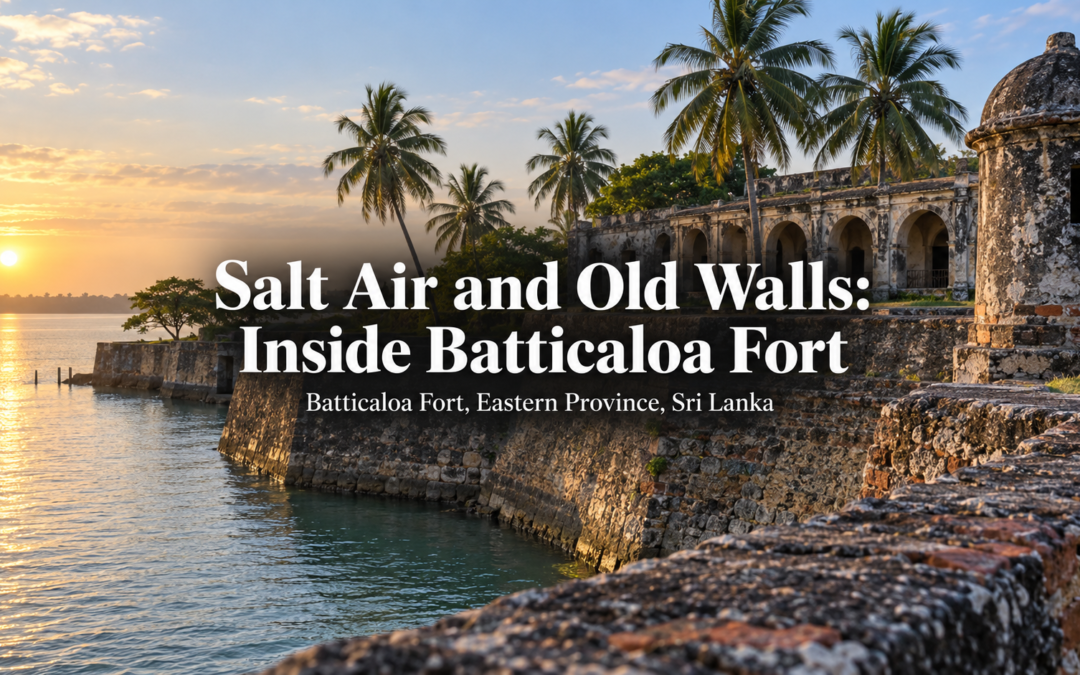
Salt Air and Old Walls: Inside Batticaloa Fort

Salt Air and Old Walls: Inside Batticaloa Fort

The lagoon is the first thing. Wide and silver-grey in the early morning, it wraps around the fort on three sides like something protective, something patient. Fishing boats sit low on the water. A man is repairing a net on the bank. Somewhere inside the old walls, a radio is playing. Batticaloa doesn’t announce itself the way Colombo does. It just opens up, quietly, and lets you walk in.

Batticaloa Fort stands on a small island in the middle of this lagoon, connected to the rest of the city by a pair of bridges. It’s been here in one form or another since the Portuguese first built a structure on this spot in 1628, and it has the scuffed, lived-in quality of a place that’s been continuously useful for nearly four centuries. Parts of it are still government offices. A court sits inside its walls. There are trees growing where cannons once stood. It’s not a museum piece. It’s a working place that happens to be very, very old.

A History Written in Three Languages

The Portuguese were first. They recognised the strategic value of this lagoon island early and built an initial fortification here in the 1620s to protect their trading interests on the eastern coast. But it was the Dutch who really built what you see today. When the VOC, the Dutch East India Company, took control of the eastern coast in 1638, they set about replacing the Portuguese structure with something considerably more serious: thick walls, proper bastions, a layout designed along the geometric principles that Dutch military engineers favoured across their empire from Galle to Batavia.

The British arrived in 1796 and inherited the whole thing along with the rest of Dutch Ceylon. They adapted it for their own administrative purposes, added some colonial-era buildings inside the walls and used it as a district hub. That layered ownership, Portuguese foundations, Dutch walls, British interiors, is what gives Batticaloa Fort its particular character. You’re not reading a single story here. You’re reading three, written on top of each other in stone.

The fort survived the civil war years largely intact, though Batticaloa itself bore enormous strain during that period. Since the end of the conflict in 2009, the city has been rebuilding steadily, and the eastern coast, long cut off from tourist circuits, has begun to open up again. There’s a lightness in Batticaloa now that feels genuinely hard-earned.

What to See

Start with the walls. Walk the perimeter as closely as the ground allows and look at the stonework properly. The Dutch construction is unmistakable: thick, low, angled bastions designed to deflect cannon fire rather than simply absorb it. The coral and stone used in the walls has weathered to a warm cream colour in places and a deeper, darker grey where the damp gets in from the lagoon. It’s beautiful in an entirely unintentional way.

The bastions at the corners are worth examining individually. Each one once housed artillery covering a different arc of the lagoon, and from the top of the accessible sections you get a proper sense of why this location was so strategically desirable. Water on three sides, a clear line of sight in every direction, a bottleneck of land that any approaching force would have to cross. The Dutch didn’t pick this spot by accident.

Inside the fort, the atmosphere shifts. Government buildings from the colonial era sit alongside older structures, some in reasonable repair, some rather less so. The old Dutch church, now in a state of partial ruin, is atmospheric in the way that roofless old buildings always are: vines threading through the window frames, the sky doing the job that a ceiling used to do. A small monument near the entrance commemorates the various powers that have held the fort. It’s modest, but worth a read.

The Batticaloa lighthouse, standing just outside the fort walls near the lagoon’s edge, is a useful landmark and offers reasonable views across the water. It’s not one of Sri Lanka’s most dramatic lighthouses, but in the context of a lagoon this calm, it has a quiet picturesqueness that photographs well in the late afternoon.

Don’t leave without standing at the lagoon’s edge for a while. The famous singing fish of Batticaloa, a phenomenon where the lagoon produces a low musical hum on certain nights, particularly around the full moon, has been puzzling and delighting people for centuries. Scientists have offered explanations involving catfish and water currents, but locals largely prefer the mystery version. If you’re there on the right night, put your ear to an oar dipped in the water. You might hear something. You might not. Either way, it’s a good excuse to be out by the lagoon after dark.

What to Do

Explore on foot and without a plan. Batticaloa’s old town, which clusters around the fort and spreads along the lagoon bank, is the kind of place that rewards wandering over itinerary-following. The streets around the fort are lined with old Tamil and Muslim shophouses, their facades painted in faded ochre and green, vendors selling fresh king coconuts from wooden carts, the smell of frying vadai drifting out of small cafes. It’s a city with a very specific texture, and you absorb it best by walking slowly and turning corners at random.

Hire a bicycle and ride the lagoon road. The route that loops around Batticaloa’s lagoon system is one of the underrated cycling experiences on the island. The road is flat, the scenery is gorgeous, and you’ll pass through fishing villages, across narrow causeways, and by stretches of water that reflect the sky so perfectly you have to remind yourself which way is up. Start early, bring water, and don’t rush it.

Take a boat on the lagoon. Several local fishermen near the fort offer short trips across the water, and even twenty minutes on the lagoon gives you a completely different perspective on the fort itself. Seeing those Dutch walls rising from the water’s edge, with the town spread behind them and the sky enormous overhead, is a genuinely memorable sight. It’s also, frankly, just a very pleasant way to spend an hour.

Make time for Kallady Beach, a few kilometres south of the town. It’s a long, clean stretch of sand on the open sea side, well away from the lagoon, and after a morning of ruins and history it offers exactly the right kind of counterbalance. The water here is rough in places depending on the season, so check conditions before you swim, but the beach itself is lovely at any time of day.

The Saturday market near the town centre is worth a visit if your timing works out. It’s a proper local market rather than a tourist one, selling fresh produce, dried fish, textiles and spices, and it gives you a useful sense of how the city actually functions day to day.

Where to Stay

Batticaloa’s accommodation scene has improved steadily since the end of the conflict, and there are now some genuinely good options across several price ranges. The city itself is compact enough that almost anywhere you stay puts you within reach of the fort.

The Riviera Resort, sitting right on the lagoon near the Kallady bridge, is the most comfortable option in town. The rooms facing the water are particularly good, and the views across the lagoon in the evening, when the light goes orange and the fishing boats come in, are hard to beat. The pool is a welcome addition after a long day in the heat.

For something with more local character, a handful of guesthouses along Lloyds Avenue and around the old town area offer simple, clean rooms with home-cooked food that tends to be excellent. Tamil cuisine on the eastern coast is distinct from what you’ll find in Colombo, with a heavier emphasis on fresh seafood and coconut-based curries. Eating at a guesthouse here is very often the best meal of the day.

If you’d like a quieter base slightly outside the town, several small properties have opened up along the Kallady road, closer to the beach. They tend to be simple and unhurried, which suits the eastern coast’s general pace well.

Getting There from Katunayake Airport

Batticaloa is roughly 310 kilometres northeast of Bandaranaike International Airport, which makes it one of the longer journeys on this Sri Lanka series. But the eastern coast rewards the effort considerably, and there are several ways to make the trip.

By train: The train from Colombo to Batticaloa is one of the great railway journeys in Sri Lanka and I’d recommend it without hesitation. From the airport, take a taxi or tuk-tuk to Katunayake Junction to board a connection to Colombo Fort, or head directly south to Colombo. From Colombo Fort, the Batticaloa Mail and the Udarata Menike service run on the eastern line to Batticaloa. The journey takes approximately seven to eight hours and passes through the Cultural Triangle, the dry zone forests of the North Central Province and the flat, luminous landscape of the east. Take a window seat. Bring food. This is not a train you want to sleep through.

By private car or taxi: A hired car from Katunayake to Batticaloa takes around five to six hours depending on the route and traffic through Colombo. The most direct route runs via the A1 to Colombo, then northeast on the A5 through Kandy and on to Mahiyanganaya, before dropping south through the eastern foothills. An alternative via the A6 and Polonnaruwa adds some time but passes through the Cultural Triangle and allows for stops at Sigiriya or the ancient city if you want to break the journey properly.

By bus: Intercity express buses run from Colombo to Batticaloa and the journey takes around six to seven hours. They’re significantly more comfortable than standard buses and air-conditioned services are available. The CTB and private operators both run this route. It’s not the most luxurious way to travel but it’s reliable and surprisingly straightforward for a journey of this length.

By domestic flight: FitsAir and other domestic carriers occasionally operate flights between Colombo’s Ratmalana Airport and Batticaloa, cutting the journey to under an hour. Services and schedules change, so check availability closer to your travel date. If the service is running and time is a priority, it’s worth considering.

Why Batticaloa Stays With You

Most people who visit Sri Lanka’s east coast say the same thing when they come back: they didn’t expect to love it as much as they did. The west coast has the established infrastructure, the well-worn tourist trail, the postcard beaches. The east has something harder to define. A quality of openness. A sense that the place hasn’t been packaged yet, that you’re seeing it before it fully knows it’s being looked at.

Batticaloa Fort is a good embodiment of that. It’s not polished. It’s not performing for anyone. It’s just an old set of walls in a lagoon city going about its business, the way it’s been going about its business for four hundred years. The lagoon shimmers. The fishing boats go out. And if you’re lucky, and the moon is right, something in the water hums.

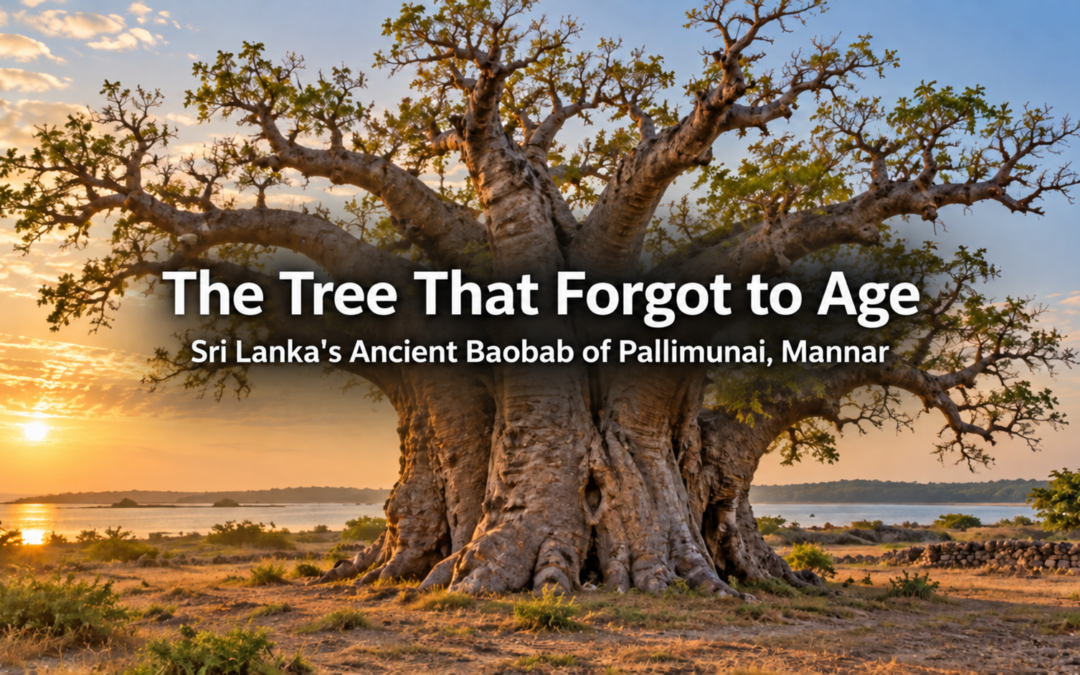
The Tree That Forgot to Age

The Tree That Forgot to Age

Sri Lanka’s Ancient Baobab of Pallimunai, Mannar

It does not greet you politely. There is no signboard at eye level, no manicured path, no gift shop selling miniature replicas. The Baobab of Pallimunai simply stands there, at the edge of the Mannar peninsula, its vast trunk the colour of old bone, its branches splayed against the sky like the arms of something that has seen far too much history and is, frankly, no longer surprised by any of it.


I had driven a long way to reach this tree. Most travellers who make it to Mannar come for the flamingos at the lagoon or the crumbling Dutch fort near the causeway. The baobab tends to get a mention as an afterthought, a curious footnote. That, I would argue, is one of the great navigational errors a person can make in Sri Lanka.


The tree is believed to be over 700 years old, possibly older. Baobabs are notoriously difficult to date with precision, partly because they do not form reliable growth rings in the way that temperate trees do, and partly because they are, in the words of one botanist I once read, “stubbornly indifferent to our timekeeping.” What is known is that baobabs are not native to South Asia. They belong to Africa and Madagascar. Their presence here, on this wind-scoured peninsula in the Northern Province, is itself a story.


The most likely explanation involves Arab traders who sailed the Indian Ocean routes centuries ago, carrying seeds from East Africa to ports along the subcontinent’s coastline. Mannar, with its ancient harbour and its position on the maritime Silk Road, would have been a natural stopping point. Someone, at some point, planted a seed here. That seed became this tree. And this tree has outlasted every empire, every occupation, and every season of war that has moved across this island since.


What to See

The tree itself is the attraction, and it earns the journey entirely on its own terms. The trunk is enormous, easily six or seven metres in circumference, and the bark has the texture of deeply wrinkled skin. In certain lights, at certain hours, it takes on a silver-grey sheen that makes it look almost otherworldly, as though it has been cast from a material that is not quite wood and not quite stone.


Walk around it slowly. Look up into the canopy, which is sparse and angular, with branches that reach outward rather than upward, as though the tree has long since given up competing for height and decided instead to claim lateral territory. During the dry season, the leaves are often gone entirely, and the silhouette becomes even more dramatic, more skeletal, more ancient.


The surrounding area has its own quiet character. The Pallimunai coastline is flat and windswept, with shallow salt flats and scrubland that gives the landscape a spare, end-of-the-world quality. On clear days, you can see Adam’s Bridge on the horizon, the chain of limestone shoals that connects Sri Lanka to India, a place that exists in both mythology and geography with equal confidence. The whole setting amplifies the strangeness of the baobab’s presence here.


What to Do

Spend time simply being with the tree. That sounds simple, and it is, but it requires a deliberate slowing down that most travellers forget to do. Sit beneath it for twenty minutes. Watch how the light shifts across the bark. Notice the birds that use it, the insects that work its surface, the way the trunk seems almost to breathe in the heat.


While you are in Mannar, the fort is worth an afternoon. Built originally by the Portuguese and later expanded by the Dutch and British, it sits on a small island connected to the main town by a causeway. Much of it is in a state of atmospheric ruin, its walls patched and crumbling, its moat dry, its cannons still pointing out to sea with a kind of stubborn optimism. It is the sort of place where history feels genuinely present rather than curated.


Mannar Island is also one of the best places in Sri Lanka for birdwatching. The lagoon on the western side of the causeway attracts large flocks of greater flamingos, particularly between November and March, along with dozens of wader and migratory species. Even if you have never been especially interested in birds, there is something quietly extraordinary about watching a thousand flamingos move collectively across still water in the early morning.


The town itself is small and unhurried. The market near the bus station sells the freshest seafood on the island, and the local speciality of dried fish, transported from here to kitchens across the country, is something you will smell long before you see it. Exploring on foot or by bicycle is the most rewarding way to move through Mannar.


Where to Stay

Accommodation in Mannar is modest and improving. The town has a small selection of guesthouses and rest houses, most of them family-run and hospitable in the way that places off the main tourist trail tend to be. The government-run Mannar Rest House is a reliable choice, positioned near the causeway with views across the water and a dining room that serves straightforward Sri Lankan food competently and without fuss.


For those who prefer something quieter, there are a handful of homestays in and around the town where hosts will, without fail, produce a breakfast that involves fresh coconut sambol and an amount of rice that seems disproportionate to the hour. Staying locally also gives you access to the kind of practical knowledge that no guidebook contains: the best spot to watch the flamingos at dawn, which road to take to avoid the worst of the afternoon traffic near the causeway, where the baobab looks most extraordinary in the particular golden light of late afternoon.


Jaffna, about 90 kilometres to the northeast, offers a wider range of hotels and guesthouses if you prefer to use it as a base for a day trip to Mannar, though the journey back in the evening does mean sacrificing the tree at dusk, which would be a genuine loss.


How to Get There from Katunayake Airport

Katunayake Airport sits on the western coast, roughly 35 kilometres north of Colombo. Mannar is approximately 265 kilometres to the north, which means you are looking at a journey of five to six hours depending on your mode of transport and how many times you stop because the road unexpectedly produces a peacock.


The most comfortable option is to hire a private car or taxi from the airport. Drivers familiar with the northern routes are readily available at the airport, and a private vehicle gives you the freedom to stop at Wilpattu National Park on the way, which shares its eastern boundary with the road north and is one of the finest leopard sanctuaries in Asia. This is worth building into the journey if time allows.


If you prefer to travel by train, the Colombo Fort railway station is about 40 minutes from the airport by taxi. From Colombo Fort, trains run north along the main line to Anuradhapura, from where you can take a connecting bus or hire a three-wheeler for the final stretch to Mannar. Anuradhapura itself is a UNESCO-listed ancient city of extraordinary importance, and a night there adds a layer to any journey north.


Long-distance buses from Colombo’s Bastian Mawatha terminal also serve Mannar directly, departing several times daily. The journey is long and the roads can be lively, but air-conditioned express services have improved significantly since the north reopened fully to tourism, and it remains the most economical way to travel.


Whichever route you take, the landscape shifts as you move north. The lush greenery of the wet zone gives way to the drier, more golden tones of the north central plains, and then to the flat, salt-bitten terrain of Mannar itself. By the time you reach the peninsula, you feel as though you have arrived somewhere genuinely apart from the rest of the island.


And then, if you go looking for it quietly, without expecting too much, you will find a tree that has been standing here since before anyone thought to write this island’s history down. It will not perform for you. It will not explain itself. It will simply stand there, enormous and indifferent and extraordinary, exactly as it has been doing for centuries, waiting for the next person who thought to make the effort to come and see.

Bahirawakanda Vihara: Kandy’s Watchful Big Buddha

Bahirawakanda Vihara: Kandy’s Watchful Big Buddha

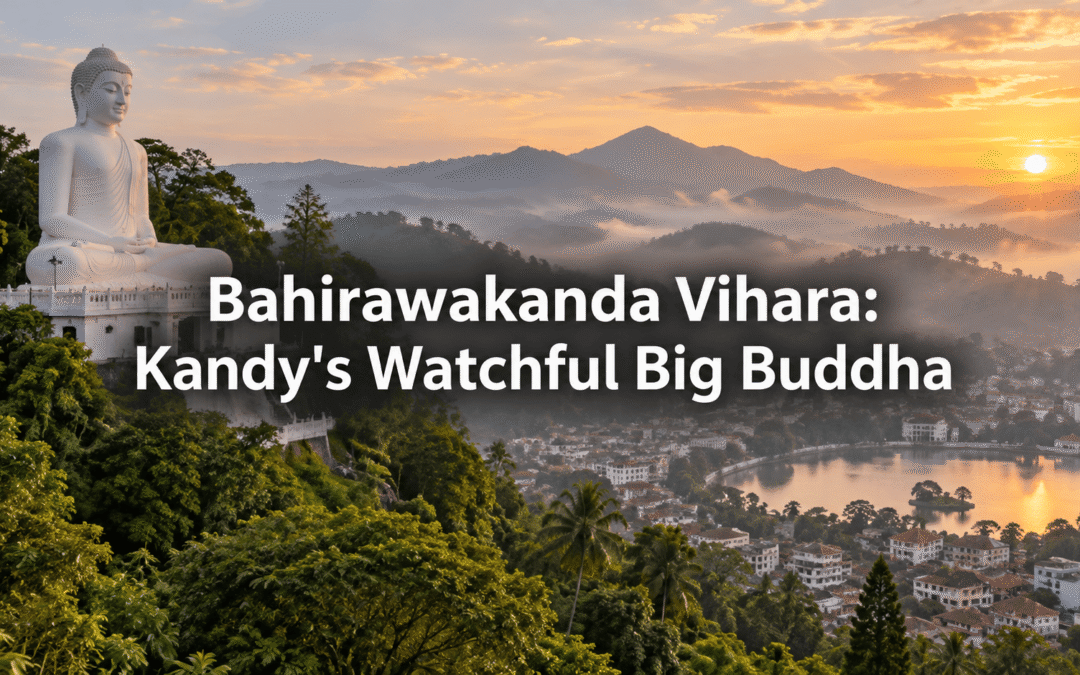
The tuk-tuk driver switched off his engine halfway up the hill and just pointed. “Look up,” he said, grinning as though he’d personally arranged the view. I did, and there it was, an 88-foot white figure glowing against the grey monsoon sky, watching over Kandy the way it has done for decades. I’d been in the city two days and had somehow missed it entirely, tucked behind rooftops and hillsides until you’re right beneath it. That’s the thing about the Big Buddha, as everyone calls it. You don’t really discover it. It reveals itself.

Bahirawakanda means something like “gnome mountain” in old local folklore, and the stories attached to the hill are wonderfully strange. Villagers once believed a malevolent spirit lived here, one that had to be appeased with sacrifices before the fear eventually faded into legend rather than belief. There’s no trace of menace left today. The hill now belongs entirely to peace, incense smoke, and the low murmur of chanting drifting up from the temple grounds.

The statue itself has a proper origin story too, and it’s more dramatic than you’d expect from something so serene. A monk named Ampitiye Dhammarama Thero first dreamed up the idea back in the early 1970s, and getting it built wasn’t straightforward. Senior monks at the Temple of the Sacred Tooth Relic opposed the project outright, worried it would overshadow their own standing in the city. It took years of petitioning, a change of political will, and land donated by the Minister of Lands before construction on the statue finally got underway in the late 1980s. It was completed in 1992 and formally opened on New Year’s Day in 1993 by the then president. So while the temple’s roots go back to the seventies, the Buddha you see today is a little younger than the hill’s legends suggest.

Whatever the timeline, the result is genuinely striking. The Buddha sits in Dhyana Mudra, hands resting in the lap in the posture of meditation, the same pose associated with the moment of his enlightenment. From below, the white marble catches every change in the light. Under a midday sun it looks almost too bright to hold your gaze. At dusk, when the yellow floodlights click on and the sky behind turns the colour of ripe mango, it becomes something else entirely, more like a lantern than a monument.

Climbing up is half the experience. You can get a tuk-tuk most of the way, but there’s still a walk from the base, up steps that wind through trees loud with birdsong and the occasional startled squirrel crossing your path. It isn’t a strenuous hike by any means, though I wouldn’t recommend attempting it in the flat sandals I’d unwisely chosen. Give yourself twenty unhurried minutes, more if you stop to catch your breath and admire the widening view, which you inevitably will.

And what a view it is. From the platform beneath the statue, all of Kandy spreads out below in one uninterrupted sweep. You can trace the glimmer of Kandy Lake, pick out the golden roof of the Temple of the Sacred Tooth Relic in the distance, and watch the hills roll away into tea country until they blur into haze. I stood there for a long while just tracking the small movements of a city I’d only known from ground level, the buses, the market stalls, the flash of a cricket match somewhere in a schoolyard below.

Inside the base of the statue itself, there’s a small gallery that’s easy to miss if you’re rushing. It traces scenes from the Buddha’s life in a series of painted panels, from his birth through to his years of teaching, and it’s worth the few extra minutes even if you’re not particularly familiar with the stories. The quiet in there feels different to the openness outside, more contained, almost hushed.

If you’re coming from the airport, the journey to Kandy takes some planning, since it’s a fair distance inland from Katunayake. A private car or pre-arranged driver is the easiest option and takes around three to three and a half hours depending on traffic through Colombo, with the added bonus of stopping wherever you like along the way. The train is the more scenic and frankly more memorable choice, though you’ll usually need to change in Colombo, and the final approach into Kandy through folded green hills is one of the loveliest short rail journeys on the island. Buses run the route too, cheaper and more frequent, though considerably less comfortable over the winding roads. Whichever way you arrive, the Big Buddha is one of the first things that announces you’ve reached Kandy, visible from the road long before you reach the city centre itself.

For where to stay, Kandy gives you options depending on what you’re after. Staying up near the hill itself puts you close to the statue and rewards you with those same sweeping views from your window, which is no small thing at sunrise. Properties around the lake put you within easy walking distance of the Temple of the Sacred Tooth Relic and the evening promenade, which fills with locals out for their walk as the light fades. A little further out, in the hills surrounding the city, you’ll find quieter guesthouses surrounded by greenery, better suited if you fancy some distance from the noise of the centre after a day of sightseeing.

I’d suggest visiting either early morning or just before dusk. The midday sun makes the climb warmer than it needs to be, and the crowds thicken through the afternoon as tour groups arrive by the coachload. Go early and you’ll have long stretches of the platform to yourself, just you, a handful of local worshippers lighting oil lamps, and that enormous, serene face looking out over a city still waking up.

Kandy has no shortage of famous sights, but there’s something about the Big Buddha that stays with you longer than most. Perhaps it’s the scale of it, or the strange folklore buried beneath the peace, or simply the fact that once you’ve seen it looking down over the city, you start noticing it everywhere, a quiet white presence on the skyline for the rest of your stay.

The Hall That Heard Kingdoms Rise and Fall

The Hall That Heard Kingdoms Rise and Fall

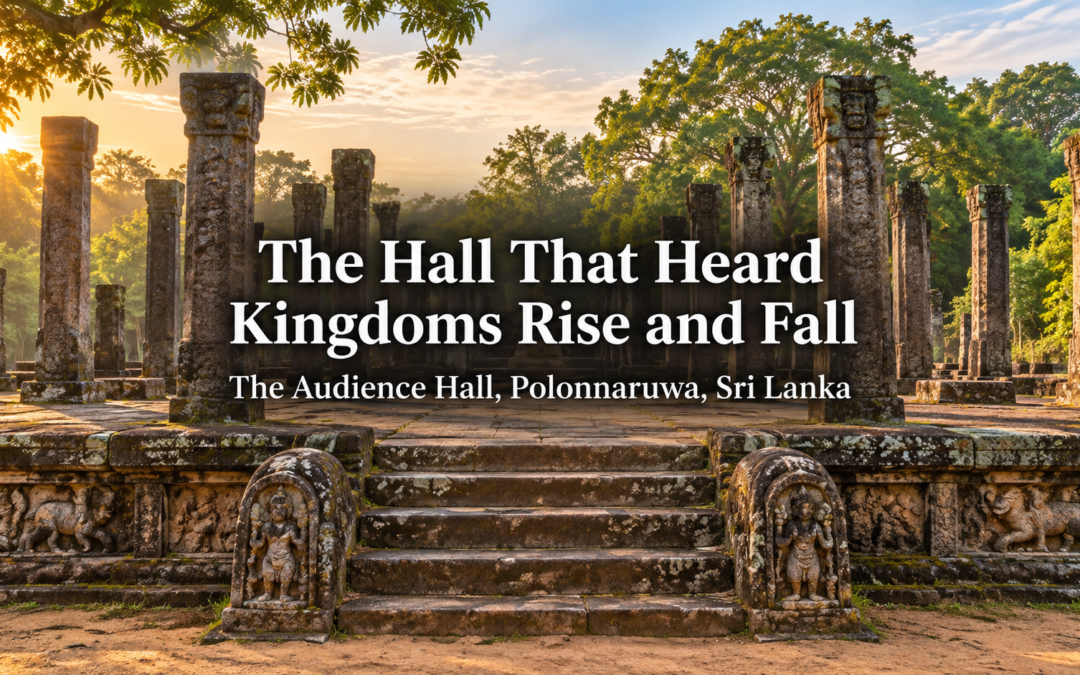
You smell the stone before you see it properly. That particular scent of old granite warmed by the morning sun, half mineral, half earth, a little like rain on dry ground. Then you step through a gap in the treeline and there it is: a raised stone platform of near-perfect symmetry, its carved pillars catching the early light, the jungle pressing in quietly from every side. Nobody else is here yet. Just you, the crows, and about nine centuries of very loaded silence.

This is the Audience Hall of Polonnaruwa. And if you’ve never heard of it, that’s a shame, because it’s one of the finest pieces of medieval stone architecture anywhere in South Asia. It doesn’t have the height of Sigiriya or the fame of the Temple of the Tooth, but what it has is something rarer: a quality of stillness that actually invites you in. You want to sit on the steps. You want to stay.

What You’re Actually Looking At

The Audience Hall was built during the reign of King Parakramabahu I, who ruled Polonnaruwa in the 12th century AD and is generally considered one of the greatest monarchs in Sri Lankan history. This was the room, or rather the open-sided platform, where the king held court, received dignitaries, issued proclamations and dealt with the daily business of running a considerable empire. Think of it less as a palace and more as an open stage for power.

The structure sits on a series of graduated stone terraces, and the whole thing is topped by a roof that’s long since collapsed. What remains is the skeleton: a series of beautifully carved granite columns arranged in precise rows across the platform, and a surrounding base decorated with one of the most astonishing friezes in the country. Rows of elephants, horses, lions and swans march around the plinth in bas-relief, carved with a confidence and fluency that makes you stop and stare. The elephants in particular are extraordinary. Each one is subtly different. Each one has weight and personality. Someone took real pleasure in carving these.

There’s also an elaborate moonstone at the main entrance, an ornamental threshold typical of Sinhalese architecture that marks the transition from the ordinary world into a sacred or ceremonial one. Polonnaruwa’s moonstones are generally considered more stylised than the earlier Anuradhapura examples, and this one is a decent specimen. Take a moment with it before you head up the steps.

What to See

The friezes are the thing. Go slowly around the entire base of the platform and look at each panel properly. The procession of animals is not merely decorative; it carries cosmological meaning, representing the layers of existence in Buddhist and Hindu thought. The elephants at the lowest tier symbolise the earth, the horses above them represent speed and royal power, the lions courage. There’s a whole cosmology worked into the stonework, and once you understand that, the carvings take on a different weight entirely.

Look at the columns themselves once you’re up on the platform. The shaft carvings are restrained but precise, and the capitals show a refinement that speaks to a highly organised workforce of skilled craftsmen. This wasn’t thrown up quickly. Parakramabahu built for permanence, and the Audience Hall reflects that intention in every chisel mark.

The Audience Hall sits within the Royal Palace complex, which means you have more to explore without going far. The Royal Palace itself, also built by Parakramabahu I, is just a few steps away and gives you a broader sense of the scale of the medieval city. The thick walls, still standing in places to a considerable height, were originally seven storeys tall. Combined with the Audience Hall, you get a genuine picture of what the ceremonial heart of Polonnaruwa looked like at its peak.

From the Royal Palace complex it’s an easy walk to the Quadrangle, the compact ceremonial precinct that contains some of the finest buildings in Polonnaruwa: the Vatadage, the Hatadage, the Atadage and the remarkable Lankathilaka. Give yourself at least a half day to cover the whole area properly. An hour will leave you feeling like you skimmed something important.

What to Do

Hire a bicycle from your guesthouse and treat the ancient city as a loop rather than a destination. The archaeological zone is flat and well-shaded in parts, and cycling through it feels appropriately unhurried. You pass lotus ponds, wild peacocks picking through the grass, stretches of crumbling wall half-swallowed by roots. It’s the kind of travel that slows your pulse down in the best possible way.

Go at dawn. I know everyone says this about every ancient site, but at Polonnaruwa it genuinely matters. The light before eight in the morning is amber and horizontal, and it does remarkable things to carved stone. The Audience Hall in that light, with long shadows thrown across the elephant friezes and nobody else around, is a version of the place that photographs can’t really capture. You have to be there for it.

If you want context before you arrive, visit the Polonnaruwa Museum first. It’s near the main entrance to the archaeological zone and houses a solid collection of artefacts from the excavations: bronzes, ceramics, coins, inscribed stones. It gives you a vocabulary for what you’re about to see, and that vocabulary makes everything more interesting. An hour there is time very well spent.

Consider a guided walk rather than cycling if this is your main focus. A good guide who knows their Mahavamsa (the ancient Pali chronicle that records much of Sri Lankan royal history) can turn the Audience Hall from a handsome ruin into a vivid scene. They know where the king sat. They know which direction the petitioners faced. Suddenly the platform isn’t empty anymore.

After the ruins, the Parakrama Samudra reservoir is worth the short ride. It’s one of the great feats of ancient Sri Lankan hydraulic engineering, a man-made lake that still irrigates farmland today. Sitting on the bank at dusk watching the water go pink is about as peaceful as travel gets.

Where to Stay

Polonnaruwa is a modest town and it doesn’t pretend to be otherwise. The accommodation scene is small but genuinely good value, and the best options cluster on the quieter outskirts rather than in the busy town centre.

The Deer Park Hotel is the standout choice in the area. It sits inside a private wildlife reserve on the edge of town, and spotted deer genuinely wander through the garden at breakfast. The atmosphere is calm, the rooms are comfortable and the pool is a serious asset after a day in the heat. It’s the sort of place that makes you want to extend your stay by a night.

The Giritale Hotel, set beside the ancient Giritale Tank, is a sound mid-range option a few kilometres outside Polonnaruwa town. The reservoir views are genuinely lovely, particularly at dusk, and the drive to the ruins takes under fifteen minutes. It’s reliable, well-run and peaceful.

For budget travellers, the guesthouses along New Town Road in Polonnaruwa offer simple, clean rooms and the kind of home-cooked Sri Lankan food that beats most restaurants. The hospitality at places like these is warm and unaffected, and you’ll often find the owners are a useful source of local knowledge about the sites.

Getting There from Katunayake Airport

Polonnaruwa is around 230 kilometres northeast of Bandaranaike International Airport, and there are several ways to cover that distance depending on your budget, your time and your appetite for adventure.

By train: Comfortably the most enjoyable option. From the airport, take a taxi or tuk-tuk to Katunayake Junction and board a train to Colombo Fort, or head to Negombo and travel down the coast. From Colombo Fort, the Batticaloa line runs northeast to Polonnaruwa. The journey takes roughly four to five hours and passes through some beautiful countryside: rice paddies, coconut groves, the dry zone scrub of the North Central Province. Second class is fine, first class is comfortable. Book ahead if you’re travelling at a weekend.

By private car or taxi: The quickest and most flexible option. A hired car from Katunayake to Polonnaruwa takes three to four hours depending on Colombo traffic, and many drivers are happy to stop at Sigiriya or Dambulla Cave Temple along the way, both of which are genuinely worth it and sit conveniently on the route. Negotiate the itinerary upfront.

By bus: Buses from Colombo’s Bastian Mawatha terminal run to Polonnaruwa regularly, and the journey takes around four to five hours. It’s the least comfortable option but also the most local. The buses are busy, the roads are lively, and you’ll arrive with a real sense of having travelled somewhere rather than merely been transported.

By self-drive: Entirely feasible if you’re comfortable driving on the left in busy Asian traffic. The E01 Southern Expressway and E03 Central Expressway clear you out of Colombo efficiently, and the A6 from Kurunegala to Polonnaruwa is a pleasant, manageable drive through open country. Just give yourself more time than Google Maps suggests. Sri Lankan roads have their own logic.

Before You Leave

There’s something about the Audience Hall that stays with you after you’ve left Polonnaruwa. Not the grandeur, exactly, because it isn’t grand in a showy way. It’s more the quiet authority of the place. A king sat here and made decisions that shaped a country. People stood on that platform and listened. The elephants carved into the base kept their patient procession, year after year, through wars and droughts and the slow creep of the jungle.

And now you’ve stood there too. You’ve read the stone in the morning light and walked the perimeter and taken your time with the friezes. That’s not a small thing. Some places in the world ask something of you, and Polonnaruwa’s Audience Hall is one of them. Go slowly. It’ll give you more than you expect.

Angurukaramulla Temple: Negombo’s Quiet Surprise

Angurukaramulla Temple: Negombo’s Quiet Surprise

Negombo doesn’t advertise itself as a temple town. Wander its streets and you’ll find church spires, a fish market that starts before dawn, and canals lined with fishing boats, all of it distinctly Catholic in flavour, a legacy of the Portuguese and Dutch who once ran this stretch of coast. So it catches you off guard to turn down a quiet side road east of the centre and find yourself walking straight into the open jaws of a dragon.

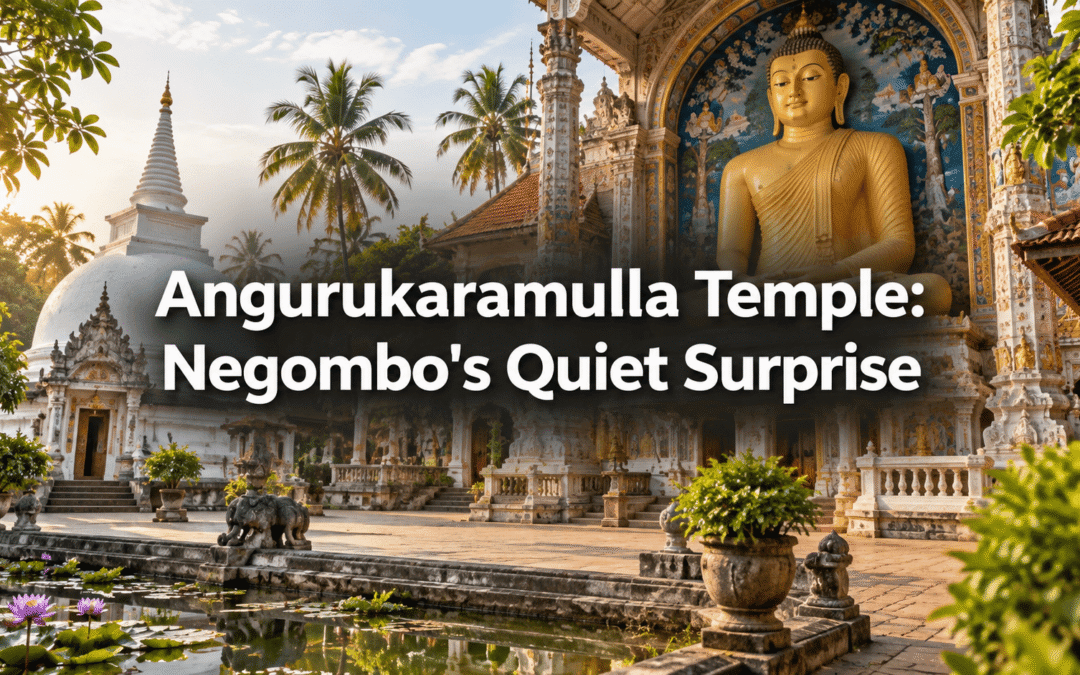
That’s genuinely how you enter Angurukaramulla Temple, also known as Bodhirajarama Maha Viharaya. The entrance is shaped as a makara, a mythical serpent-like creature from South Asian folklore, its mouth stretched wide enough to walk through. Passing between its teeth is meant to symbolise leaving the ordinary world behind, and whatever your beliefs, it’s hard not to feel a small shift in mood as you step through into the temple courtyard beyond.

Inside, the contrast with Negombo’s coastal calm continues. Where the town outside is all salt air and unhurried fishing routines, the temple grounds are a riot of colour and detail. Painted ceilings trace the Buddha’s life story panel by panel. Murals depict old Sinhalese kings and scenes from the Mahavamsa, the island’s great historical chronicle, alongside more unsettling depictions of Buddhist hell meant to warn against wrongdoing. It’s not a subtle place. Every surface seems to be telling a story, and you could spend an hour just following the paint from wall to ceiling and back again.

The temple’s exact age is genuinely uncertain, which only adds to its appeal. Parts of the site are believed to be more than three hundred years old, and there’s a crumbling, moss-covered library on the grounds that some locals claim predates the temple itself. Nobody seems entirely sure, and the monks who tend the grounds today seem happy to let the mystery stand rather than pin it down with a plaque.

The centrepiece, depending on who you ask, is either the seated Buddha statue rising some six metres inside the main image house, painted in soft, deliberate colours and radiating an easy calm, or the reclining Buddha stretched out nearby, one of the longest of its kind in Sri Lanka at close to fifteen metres. I found myself drawn back to the reclining figure more than once. There’s something about its scale, and the stillness of the pose representing the Buddha’s final moments before passing into nirvana, that makes the room around it go quiet even when it’s full of visitors.

Elsewhere on the grounds there’s a hall lined with life-sized statues of Sri Lankan kings, running from the island’s first recorded ruler through to the last monarch before British colonisation took hold. It’s an unexpected history lesson tucked inside a place of worship, and one that ties the temple’s spiritual role to the island’s political past in a way that feels distinctly Sri Lankan. Walking down the row of them, painted robes and crowns picked out in gold leaf, faces set in the same stern expression from one king to the next, it struck me how rarely temple visits double as history lessons quite this directly. Most places give you spirituality or history. This one insists on both at once, and somehow it works.

Outside, the pace slows right down again. A pond near the entrance holds a slow procession of turtles drifting beneath the surface, and the trees around the courtyard offer proper shade if you need a break from the murals and the midday heat. Locals come and go quietly through the afternoon, lighting incense, offering flowers, going about a routine that clearly has nothing to do with tourism.

Getting here from Katunayake Airport is refreshingly simple, since Negombo sits just a short distance up the coast. A private car or taxi will have you at the temple in well under half an hour, making it an easy first or last stop on a Sri Lankan itinerary. Tuk-tuks are plentiful around Negombo itself and will get you there for a modest fare, agreed before you set off. There’s no train station directly serving the temple, but if you’re coming in from Colombo, buses run regularly along the coast road and drop you within walking distance, with a short stroll inland from the main road to reach the entrance.

Negombo has plenty of places to stay, most of them clustered along the beach strip a short drive from the temple. Beachfront hotels here tend to be relaxed and unfussy, popular with travellers breaking a long-haul flight or easing into island time before heading further afield. Guesthouses tucked into the quieter lagoon-side streets offer a more local pace, often run by families who’ll happily point you toward their own favourite spots for the day’s fish curry. Given how close the airport is, some visitors treat Negombo as a single overnight stop, though the town, and this temple in particular, rewards a slower look. Spend even one extra day here and the pace of the place starts to sink in properly, the early morning fish auctions, the slow canal-side walks, the church bells that seem to compete good-naturedly with the temple’s own quiet rhythms.

Try to visit in the late morning, once the earliest devotees have come and gone but before the afternoon heat settles properly into the courtyard. Dress modestly, covering shoulders and knees, and don’t rush the murals, even the ones near the exit that visitors often skip on their way back out through the dragon’s mouth. It’s worth pausing there too, since some of the smaller painted panels near the entrance are easy to miss on the way in when the dragon’s mouth is still the main attraction pulling your eye upward.

What stays with you afterwards isn’t just the reclining Buddha or the painted ceilings, impressive as they are. It’s the sheer unexpectedness of the place, a burst of colour and old story-telling sitting quietly behind a coastal town better known for its churches and its fish. Negombo gives you the sea and the sky. Angurukaramulla gives you something else entirely, and it’s worth every minute of the detour.