
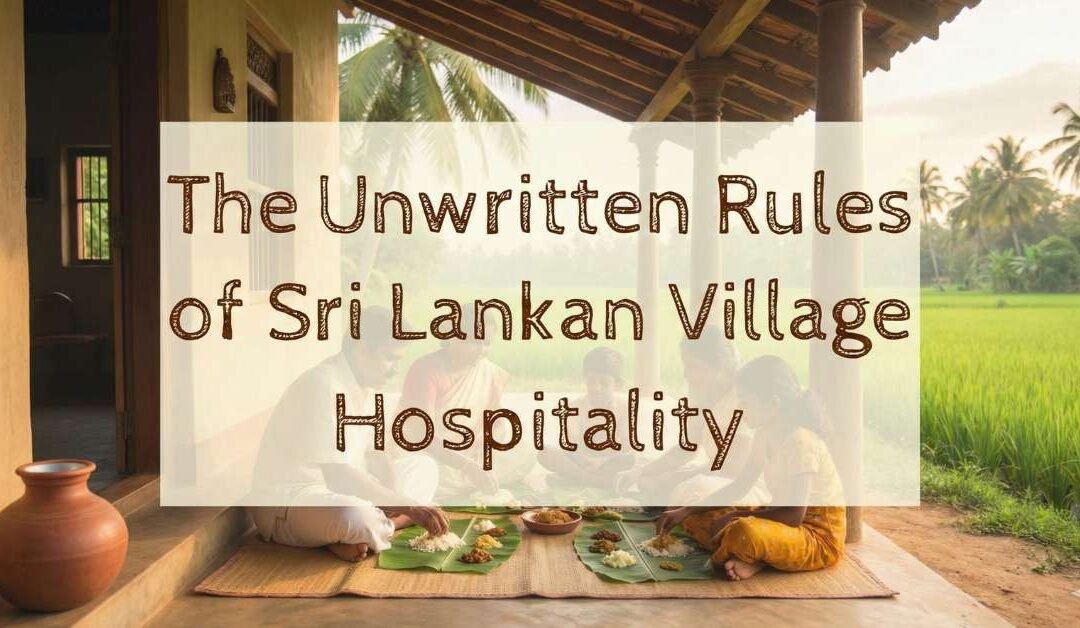
The Unwritten Rules of Village Hospitality

The Unwritten Rules of Village Hospitality

I arrived in Meemure the way most people do: dusty, slightly disoriented, and with the faint suspicion that Google Maps had finally decided to prank me. The road narrowed into a suggestion rather than a promise, the signal vanished, and the mountains of the Knuckles Range rose like a quiet warning: you’re not in charge here anymore.

That, I would soon learn, is Rule Number One of village hospitality in Sri Lanka: arrive humble.

Meemure isn’t the kind of place you “visit.” You are received. The village doesn’t roll out welcome signs or glossy brochures. Instead, it watches you first. From doorways. From paddy fields. From the edges of footpaths where barefoot children pause mid-game to decide whether you’re interesting or just another confused outsider.

By the time I reached the village centre, if you can call a cluster of homes, a temple, and a school a “centre”, I had already broken into a sweat and a smile. A man sitting on a wooden bench nodded at me. Not a greeting, not a question. Just a nod. I nodded back. Another rule unlocked: don’t overdo it. Enthusiasm is fine. Loud enthusiasm is suspicious.

Rule Two: You Will Be Fed (Resistance Is Futile)

I had barely put my bag down before the first offer came.

“Tea?”

In Meemure, tea is not a beverage. It is a declaration of intent. Saying no is theoretically possible, in the same way it’s theoretically possible to swim upstream during a monsoon.

The tea arrived strong and sweet, accompanied by something fried, something steamed, and something that looked like it had been invented specifically to test my willpower. I hadn’t asked what any of it was. That’s Rule Three: don’t interrogate the food like it’s a crime suspect.

Village hospitality doesn’t ask about your diet preferences, your allergies, or your relationship with carbs. It operates on a simpler belief system: If you are here, you must eat. Food is how villagers say hello, how they say stay, and how they say you’re safe now.

Later, I’d learn that every house I passed had quietly discussed whether I had eaten enough. Not eaten at all—enough. Portions are watched with concern. Seconds are encouraged with enthusiasm. Third helpings are met with satisfied smiles.

Rule Three-and-a-Half: The Kitchen Is Sacred (But You’re Still Welcome)

At some point, I wandered toward the kitchen area, curious about the orchestra of smells. Immediately, a gentle protest arose.

“No, no, sit.”

This wasn’t exclusion. It was respect. The kitchen is where magic happens, where generations of muscle memory guide hands that don’t need measuring cups or timers. But if you linger long enough, curiosity outweighs protocol. You’ll be handed a coconut scraper, or asked to hold something, or simply allowed to watch.

And if you praise the food—even clumsily—you will be remembered forever.

Rule Four: Conversations Move at the Speed of Trust

Village conversations don’t start with questions like What do you do? They start with the weather, crops, last night’s rain, or whether the river is behaving itself.

In Meemure, time stretches. People talk in pauses. Silence isn’t awkward; it’s punctuation. I sat on a verandah one evening, watching mist roll down the hills, and realised no one was trying to “entertain” me. That was another rule: you are not the guest of honour—you are part of the background now.

Eventually, stories emerge. About elephants wandering too close. About a child who moved to the city. About how things used to be when the road was worse, the nights darker, and life somehow simpler and harder at the same time.

You listen more than you speak. And when you do speak, you keep it honest. Villages have a finely tuned radar for nonsense.

Rule Five: Footwear Is Optional, Respect Is Not

Shoes come off often in Meemure. At doorsteps. Near temples. Sometimes, just because it feels right. No one announces it. You notice by watching feet.

This extends beyond footwear. Respect is shown in posture, in tone, in the way you accept what’s offered without acting like it’s exotic or strange. Taking photos without asking feels wrong here, even if no one stops you. Another unwritten rule: if it feels like you should ask, you should ask.

When permission is given, it’s wholehearted. Smiles widen. People straighten their sarongs, brushtheir hair back, and call others into the frame. Hospitality, once unlocked, becomes generous to the point of embarrassment.

Rule Six: Mornings Belong to the Village

I woke up early on my first morning to the sound of roosters arguing with the concept of dawn. Mist clung to everything. Somewhere, a radio played softly. Someone was already sweeping the yard with a handmade broom, the rhythm steady and meditative.

No one sleeps in late in a village unless they’re sick or very old. The day begins with purpose. Cows are tended to. Fields are checked. Water is fetched. Even breakfast feels like a checkpoint rather than a destination.

As a visitor, you’re not expected to work—but you’re expected to notice. To appreciate that life here is shaped by daylight and seasons, not notifications. That awareness, I realised, is another form of respect.

Rule Seven: You Will Be Walked Home (Even If Home Is Three Steps Away)

One evening, after sitting and talking long past sunset, I stood up to leave.

“Wait,” someone said.

A lantern appeared. Then another person. Then a child, inexplicably holding a stick as if it were a ceremonial guard duty. I tried to protest. Laughed it off. That didn’t work.

Walking someone home is not about safety alone. It’s about care. About closing the loop. About making sure the day ends properly. Even if your place is visible from where you’re standing, someone will walk with you until the goodbye feels complete.

This rule is non-negotiable.

Rule Eight: Gifts Are Given Quietly

Village hospitality isn’t transactional. No one expects anything from you. Which somehow makes the smallest offering feel enormous.

On my last day in Meemure, I was handed a bag of homegrown produce. No speech. No explanation. Just a casual “for the road.”

Refusing would have been rude. Making a big deal out of it would have been worse. The correct response, I learned, is gratitude without performance. A smile. A thank you. And the promise spoken or unspoken that you’ll remember.

The Final Rule: You Don’t Really Leave

When I finally left Meemure, the village didn’t wave goodbye dramatically. Life continued. Someone swept a yard. Someone called out to a neighbour. The mountains stayed exactly where they were.

But I carried something with me that wasn’t in my bag.

Village hospitality in Sri Lanka doesn’t try to impress you. It doesn’t sell itself. It simply opens a door and trusts you to behave like a decent human once you’re inside.

The rules are unwritten because they don’t need to be written. You feel them. You learn them by watching, by listening, by being gently corrected when you get it wrong.

And long after the dust has settled on your clothes and the road has widened again, you realise the real gift wasn’t the food, or the walks, or the tea.

It was the quiet lesson that hospitality, at its best, isn’t about hosting at all.

It’s about belonging, even if only for a little while.
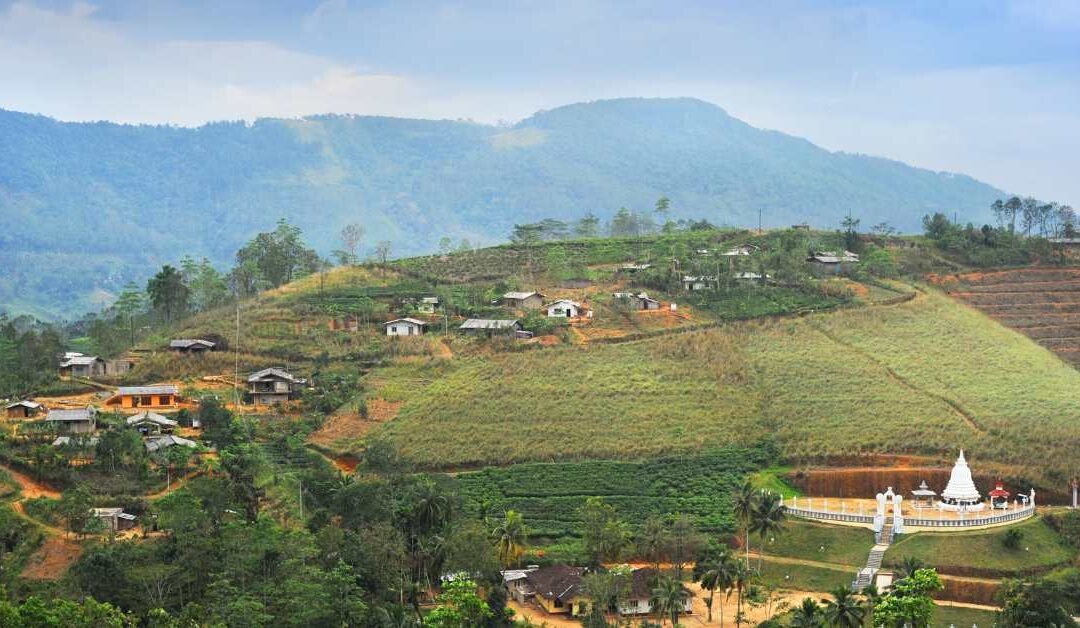
Village Gossip, Community News & the Role of the Boutique

Village Gossip, Community News & the Role of the Boutique

I didn’t plan to learn the social structure of a Sri Lankan village from a boutique, but that’s how it happened. Not from a council meeting, not from a newspaper, not even from a temple sermon—but from a small roadside shop no bigger than a living room, where biscuits were stacked like architecture and gossip moved faster than electricity.

In Sri Lanka, the boutique is not just a shop. It is a newsroom, a parliament, a notice board, and sometimes a courtroom. And once you start paying attention, you realize that almost everything worth knowing passes through it.

The First Boutique Lesson

My education began on a plastic chair outside a village boutique somewhere between paddy fields and a road that only pretended to be straight. I had stopped for water and shade. What I stayed for was the conversation.

A motorbike arrived. Engine off. Helmet removed. News delivered.

Someone’s cousin had returned from the Middle East. A bus had broken down near the junction. The price of coconuts was behaving strangely again. None of this was announced formally. It was released, gently, into the air—like incense.

I hadn’t even opened my bottle yet, and already I knew more about the village than any map could tell me.

The Boutique as a Living Organism

A Sri Lankan boutique is rarely silent. Even when no one is speaking, something is happening. A radio hums. A kettle rattles. Coins clink against the counter with a familiarity that suggests they’ve lived here their entire lives.

The shopkeeper—usually seated, sometimes standing, always watching—is the quiet axis around which everything turns. They don’t interrupt. They don’t editorialize much. They absorb.

If the village had a memory, the boutique would be it.

Here, community news doesn’t arrive in headlines. It arrives in fragments—a  sentence cut short; a raised eyebrow; a pause that lasts half a second too long.

You learn quickly that what isn’t said often matters more than what is.

Gossip, But Make It Infrastructure

The word “gossip” feels unfair here. What happens in a boutique is closer to information management.

Yes, people talk about people—but they also talk for people. News travels fast because it needs to. Someone is sick. Someone needs help. Someone’s roof didn’t survive the rain. The boutique is where this information becomes collective responsibility.

I watched a conversation unfold once where a woman mentioned—casually, almost accidentally—that her neighbor hadn’t opened their shop that morning. Within minutes, someone had decided to check in. Another offered to bring food. A third nodded and said nothing, which meant they would handle the rest.

No phones were exchanged. No lists were made.

The boutique handled it.

Morning News vs Evening News

There are different editions of boutique news.

Morning gossip is practical. Who left early. Which bus was late. Whether the road ahead is flooded or merely pretending to be. Farmers exchange updates that sound vague but are actually precise. A single comment about the wind direction can carry an entire weather forecast.

Evening gossip is reflective. This is when stories stretch their legs. When past events are re-examined, sometimes gently corrected, sometimes dramatically improved.

I learned quickly that if you want facts, come early. If you want truth, come late.

The Boutique Bench

Almost every boutique has a bench or two outside—plastic, wooden, or improvised from something that once had another purpose. These benches are not seating. They are membership.

Sit too confidently, and you’re suspicious.

Sit too hesitantly, and you’re invisible.

I learned to sit like someone waiting for something, even when I wasn’t sure what that was. It worked. People spoke around me at first, then to me, then—eventually—through me, using me as a neutral audience to float half-formed opinions.

That’s when you know you’ve been accepted.

The Boutique and the Temple

The relationship between the boutique and the temple is an interesting one. One handles the spiritual order. The other handles everything else.

Festival dates, almsgiving plans, procession routes—all of it gets confirmed at the boutique before it becomes official. If the temple is the heart, the boutique is the circulatory system.

I once watched a disagreement about a festival schedule get resolved not at the temple, but over tea beside a biscuit display. The conclusion was never announced. It simply took effect.

Politics, Carefully Measured

Politics enters the boutique the way spice enters Sri Lankan food: deliberately and with restraint.

No one shouts. Opinions are tested lightly, like tapping a coconut to see if it’s good. A comment is made. A pause follows. If no one reacts, the subject changes.

If someone reacts, the conversation deepens—but never too far. The boutique values harmony over victory. Arguments here are softened by laughter, redirected by tea, or postponed indefinitely.

I realized that the boutique isn’t a place for being right. It’s a place for remaining connected.

Children, Ice Pops & Intelligence Gathering

Children treat the boutique like a headquarters. They arrive in groups, buy one thing collectively, and leave with several pieces of information they weren’t looking for.

They know who’s visiting. Who’s fighting. Who’s pretending not to talk to whom.

By the time they grow up, they’ve already completed an informal degree in social navigation.

Watching this, I understood how village knowledge survives generations without being written down.

The Outsider Test

As a traveler, I was always being evaluated—kindly, subtly, constantly.

The boutique is where that evaluation happens.

Do you greet people? Do you wait your turn? Do you listen more than you speak?

Answer correctly, and the village opens up. Homes become accessible. Stories become personal. You stop being “the visitor” and start being “the one who sat there that day.”

Fail, and you’ll still be treated politely—but the deeper layers remain closed.

When the Boutique Closes

On rare occasions, a boutique is closed. When this happens, the village feels it immediately.

People slow down. Conversations scatter. News becomes delayed.

It’s like losing signal.

You realize then how much emotional infrastructure is contained within those walls.

What the Boutique Taught Me

By the time I left the village, I realized I hadn’t just learned about gossip or community news. I had learned about trust.

The boutique works because people return. Because they speak carefully. Because they understand that words, once released, don’t belong to them anymore.

In a world obsessed with speed and volume, the Sri Lankan village boutique offers something radical: attention.

It doesn’t amplify voices. It balances them.

And if you’re lucky enough to sit on the right bench at the right time, you’ll hear the real story—not shouted, not announced, but passed gently from one human to another.

That, more than anything I saw on this journey, felt like the true heart of the village.