by Travel Nomad | Jun 28, 2026 | Sri Lanka |
The south coast of Sri Lanka has, in the past decade, become one of the most visited stretches of coastline in Asia. Galle draws the boutique travellers. Mirissa draws the whale watchers. Hiriketiya draws the surfers. Each of these places is genuinely good, and each of them is, at certain times of year, genuinely crowded. But there is another south coast. One that sits just beyond the reach of the standard itinerary, where the beaches are unorganised, the lagoons are full of birds rather than sunbathers, and the communities that live along the water have not yet reoriented their entire lives around the business of tourism.
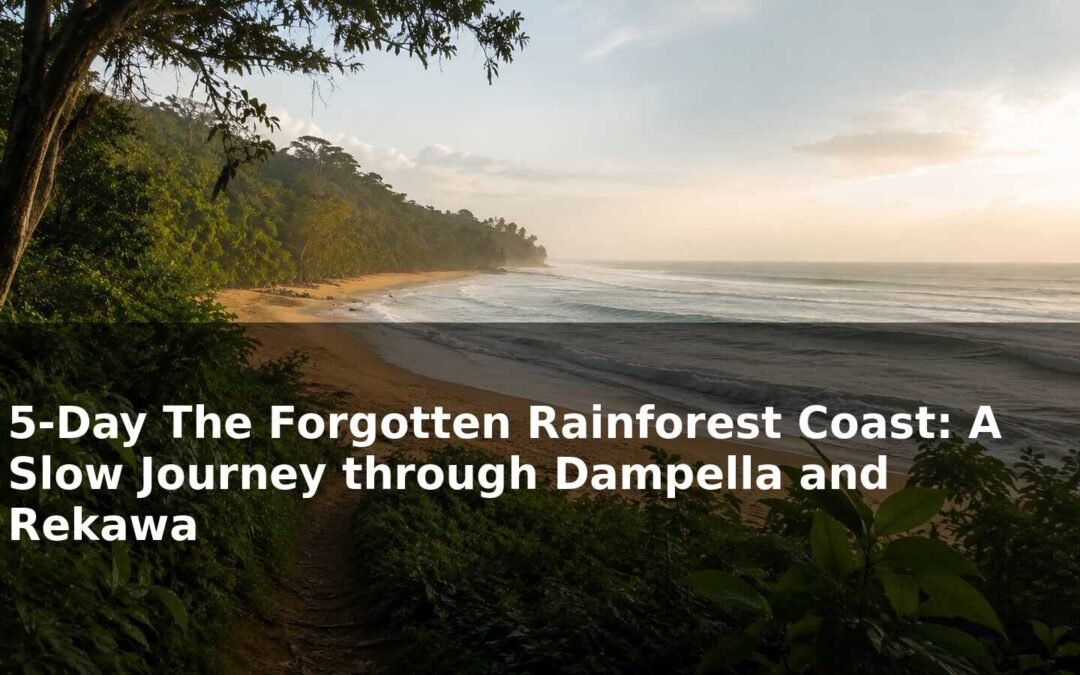
Rekawa and Dampella sit on this quieter stretch, east of Tangalle, where the coast begins to lose its polish and recover something more honest. The lagoons here are wide and shallow and rich with life. The beaches are long and largely empty. And on certain nights between April and September, the largest nesting population of sea turtles in Sri Lanka comes ashore in the dark to lay their eggs in the sand, watched by almost nobody.
Five days here will not give you spectacle in the conventional sense. What it will give you is the particular satisfaction of a place that has not yet been fully discovered, experienced at exactly the right moment.
Day 1 – Arriving in Tangalle
Use Tangalle as your entry point. It is the nearest town of any size to the Rekawa lagoon, about twenty minutes to the east, and it has enough infrastructure to be comfortable without having lost its essential character as a working coastal town. The harbour here is one of the more active on the south coast, and arriving in the late afternoon when the fishing boats are coming in gives you an immediate and unpretentious introduction to the economy of this coastline.
Walk the harbour in the evening. The boats are wooden and brightly painted, each one bearing a name in Sinhala and a small Buddhist or Hindu emblem near the prow. The catch is unloaded fast and without ceremony, sorted on the jetty, and moved directly to the buyers who are already waiting. It is a transaction that has been happening in this harbour for centuries, and it proceeds with the efficiency of something that has been repeated so many times that every gesture has been reduced to its absolute minimum.
For accommodation in Tangalle, Buckingham Place is a well-regarded boutique property on its own stretch of beach, with thoughtfully designed rooms and a genuine commitment to the surrounding environment. For a more budget-conscious stay, the small guesthouses along the Tangalle lagoon road offer clean rooms and good home cooking at very reasonable prices, with the lagoon visible from most windows.
Day 2 – The Rekawa Lagoon and the Wetlands
The Rekawa Lagoon sits behind the beach of the same name, separated from the sea by a narrow sandbar that the turtles cross at night on their way to nest. During the day, the lagoon is a working ecosystem of considerable richness. The shallow water supports dense populations of wading birds, the mangrove edges are alive with kingfishers and herons, and the open water in the morning light has a glassy, undisturbed quality that makes it feel genuinely remote despite being only a short drive from Tangalle.
Hire a small boat from the village at the lagoon entrance and spend the morning on the water. The boatmen here are local fishermen who know every channel and sandbank, and who have been working this lagoon long enough to read its moods accurately. The bird watching from the water is excellent throughout the year, but particularly good between November and April when migratory species swell the resident population considerably.
The wetlands of Dampella, a short distance along the coast, extend the same ecosystem westward through a series of interconnected lagoons and marshes that receive almost no visitor attention. The road that runs along the inland edge of these wetlands passes through a landscape of paddy fields, coconut groves, and small fishing settlements that has a quietly beautiful, unedited quality. Stop whenever something catches your eye. This is not a road with a schedule.
Day 3 – The Turtle Beach at Night
The Rekawa turtle project is one of the oldest community-based conservation initiatives in Sri Lanka, established in the 1990s and run largely by the local fishing community, whose members were, before the project began, among the primary collectors of turtle eggs on this beach. The transformation from harvesting to protecting is not a simple story, and the community members who now guide visitors to the nesting sites at night are frank about its complexity if you ask them directly.
Five species of sea turtle nest on Sri Lankan beaches. All five have been recorded at Rekawa, though the green turtle is by far the most common here. The nesting season runs from April through September, with peak activity in the middle months. The turtles come ashore after dark, typically between eight in the evening and two in the morning, and the wait on the dark beach for the first one to emerge from the surf is part of the experience rather than a prelude to it.
The protocol is carefully managed. No torches, no flash photography, no approaching the turtle until the guide gives the signal. When a female has settled into her nesting rhythm and begun laying, she enters a state of focused calm that allows a small group to observe at close range. The eggs are white and soft-shelled, arriving in a steady stream into the nest chamber she has excavated with her rear flippers. When she is finished, she covers the nest, turns back to the sea, and is gone. The whole process takes between one and two hours, and the beach is quiet and dark throughout.
Spend the preceding afternoon resting. The evening is a late one, and the experience is better approached without fatigue.
Day 4 – The Fishing Villages and the Portuguese Churches
The coastal villages between Rekawa and the Hambantota district boundary are predominantly Catholic, their faith a legacy of the Portuguese period that has proved considerably more durable than the Portuguese political presence. The small whitewashed churches that anchor these villages, most of them rebuilt several times over the centuries but always on the same foundations, hold Sunday mass in communities where the same family names have appeared in the parish register for four hundred years.
Visit one of these churches on a weekday morning when the building is quiet and the priest, if he is present, is usually willing to talk. The interiors are simple and well-kept, the statuary painted in the vivid colours that characterise Catholic folk art across the Portuguese colonial world, the atmosphere one of a faith that is genuinely lived rather than performed for visitors. The cemeteries beside them carry the same Portuguese surnames across generations of headstones, a compressed record of a community that stayed when the empire that created it moved on.
The fishing culture in these villages has its own distinct character, different from the Buddhist fishing communities further west. The boats are similar, the techniques largely the same, but the rhythms of the week are organised around the church calendar, and the festivals that mark the major saints’ days are community events of considerable energy and colour.
Day 5 – The Coast Road and a Slow Departure
Use the final morning for the coast road east toward Hambantota, which passes through a landscape that shifts noticeably from the lush, lagoon-rich terrain of Rekawa into the drier, more open scrub of the deep south. The change happens gradually and then all at once, the coconut groves thinning, the soil lightening, the sea taking on the harder, more brilliant blue of a coast with less cloud cover.
Hambantota itself, now dominated by the infrastructure of the new port, is less interesting than the country around it. The Bundala National Park, a few kilometres west of the town, is worth a morning if your timing allows. It is a coastal wetland of international significance, home to large flocks of flamingos in the right season and to elephants that move through the park on their way between the inland forests and the coast. The birding here is among the best in the south, and the landscape, flat and wide and open to the sky, has a spare, elemental quality that makes a good final note for a journey that has been, throughout, about the quieter and more honest version of this coast.
Where to Stay
In Tangalle, Buckingham Place is the standout choice for comfort and setting, with budget guesthouses along the lagoon road offering good value alternatives. For travellers who want to be closer to the Rekawa beach for the turtle watching, a handful of small homestays in Rekawa village itself offer very simple accommodation at minimal cost, and staying in the village rather than driving in from Tangalle makes the evening experience considerably more relaxed. In Hambantota, Peacock Beach Hotel provides reliable mid-range accommodation if you choose to end the journey there rather than returning to Tangalle.
Tangalle: Quiet Coastal Boutiques
While Buckingham Place is an excellent anchor, Tangalle’s surrounding beaches hide a few more architectural and eco-focused gems for travellers who want absolute serenity before heading to the lagoons.
- The Last House: Situated on the secluded Mawella Beach, this is famously Geoffrey Bawa’s final architectural masterpiece. It offers a barefoot-luxury, boutique experience with just six bedrooms. It perfectly captures the unpretentious, slow-paced charm the itinerary aims for, blending tropical modernism with the raw southern coast.
- Lankavatara Ocean Retreat & Spa: Located slightly east toward Kalametiya, this boutique retreat sits right on a deserted stretch of sand. It’s incredibly quiet and focuses heavily on integrating with the natural environment, making it an ideal bridge between the coastal town vibe and the wetland ecosystems.
Rekawa: Lagoon & Nature Immersion
If you prefer to stay right in the heart of the turtle nesting grounds and wetland ecosystems rather than driving in from Tangalle, these options put you directly in nature.
- Rekawa Wellness Resort: Nestled right in the coastal forest near the beach, this eco-resort focuses heavily on Ayurvedic wellness, yoga, and sustainable living. It’s built from local materials and allows you to experience the glassy mornings on the lagoon and the quiet nights waiting for turtles without breaking the spell of the environment.
- Seven Turtles Resort: A small, highly-rated boutique hotel situated right on Rekawa beach. It is purposely far from the crowds, offering a very relaxed front-row seat to the wild beach where the turtles come ashore.
Hambantota / Bundala: The Drier Deep South
Instead of staying in the centre of Hambantota town, shifting slightly west toward the Bundala National Park wetlands offers a much more atmospheric end to the trip.
- Flameback Eco Lodge: Located near the Weerawila lake system bordering Bundala, this eco-lodge offers luxury glamping in a spectacular bird-watching environment. It matches the blog’s description of the “spare, elemental quality” of the deep south, allowing you to wake up to the sounds of the wetlands right outside your canvas.
If you want to skip the boutique hotels and stay right on the sand or the lagoon edge in Rekawa, there are several excellent, low-key cabanas and homestays. These spots lean fully into the unpolished, nature-first vibe of the area.
Here are the best budget-friendly options that keep you close to the turtles and the wetlands:
Beach & Lagoon Cabanas
- Mangrove Beach Cabanas: These rustic, wooden cabanas sit almost exactly where the lagoon meets the ocean. They are simple but incredibly atmospheric, built directly into the coastal forest. It’s the perfect base if you want to split your time between kayaking the lagoon in the morning and walking the quiet beach at night.
- Garden Oasis Rekawa: Located just a short walk from the turtle nesting beaches, this property offers uniquely designed, arched wooden cabins set in a lush garden. It is highly rated for its quiet isolation and the hospitality of the local hosts, making it a very relaxed spot to rest before a late night on the beach.
Simple Local Homestays
- Turtle Moon Lodge: A very simple, clean homestay practically on the beach. What you save on luxury you make up for in access—the owners are deeply knowledgeable about the area and the turtles, and you are just steps away from the sand.
- Soma Residence & Cabanas: A classic Sri Lankan family-run homestay near the Rekawa Road junction. They offer standard rooms and simple garden cabanas. It’s an excellent choice if you want authentic, home-cooked southern Sri Lankan food and a welcoming family atmosphere just five minutes from the water.
- Turtle Paradise: True to its name, this is a no-frills guesthouse situated right on the Rekawa beach strip. It is highly favored by travelers whose sole priority is to slow down, watch the ocean, and walk to the turtle conservation project at night without needing a tuk-tuk.
by Travel Nomad | May 11, 2026 | Sri Lanka |
The rock appears before the road is ready for it. You’re moving through flat scrubland, teak forests and small villages selling king coconuts by the roadside, and then, without much warning, Yapahuwa simply rises out of the earth. A great slab of granite, almost ninety metres tall, erupting from the plain as though someone pushed it up from below. It doesn’t look like something that belongs in this landscape. It looks like a declaration.
Most travellers heading between Colombo and Kandy or Anuradhapura have no idea they’re passing within a few kilometres of one of Sri Lanka’s most extraordinary medieval sites. Yapahuwa was briefly the capital of the Sinhalese kingdom in the 13th century. It housed the Tooth Relic of the Buddha, the most sacred object in the country, for over a decade. Kings built a palace on its summit and a ceremonial staircase up its flank that’s carved so finely it still stops people cold today. And then history moved on, the jungle moved in, and Yapahuwa was largely forgotten for six hundred years. It’s still slightly forgotten now. Which is exactly why you should go.
A Capital for Thirteen Years
The story of Yapahuwa is, at its core, a story about instability. The 13th century was not a comfortable time to be a Sinhalese king. South Indian invasions from the Pandya and Chola kingdoms had repeatedly destabilised the north of the island, forcing successive rulers to relocate their capitals southward in search of defensible ground. Polonnaruwa had fallen. Dambadeniya had served as a temporary capital. By around 1272, King Bhuvanekabahu I chose Yapahuwa, and it’s not hard to see the logic. That rock is not something you take easily.
The fortress complex he built here included a palace on the upper rock, a series of defensive walls and moats around the base, temples, and most significantly, the ornamental staircase leading to the upper terrace where the Tooth Relic was enshrined. For roughly thirteen years, this was the spiritual and political centre of Sinhalese Buddhist civilisation. Then in 1284, a Pandyan force took the rock, seized the relic and carried it to South India. It was returned some years later under a subsequent king, but the capital never recovered its momentum. By the early 14th century, Yapahuwa was effectively abandoned. Monks settled in the caves around the base, as they had done before the fortress was built, and the jungle began its quiet, thorough work.
Archaeological excavations began in earnest in the 20th century, and what they’ve uncovered is remarkable. The site is partially cleared now and reasonably well maintained, but it retains the overgrown, half-discovered quality of a place that the modern world hasn’t fully caught up with yet. That’s a large part of its appeal.
What to See
The staircase is the heart of the visit, and nothing quite prepares you for it. Halfway up the rock, a grand ceremonial flight of steps rises between two pavilions towards the upper terrace shrine room. The carvings on the balustrades and facades of these pavilions are among the finest examples of late Polonnaruwa-period decorative stonework in existence. Makaras, those mythological sea creatures that serve as architectural sentinels across South and Southeast Asian sacred buildings, rear up from the balustrade ends with tremendous energy. Lionesses flank the steps. Geese carved in procession run along the friezes. Every surface is doing something.
What makes it particularly affecting is the setting. This isn’t a carving behind glass in a museum. It’s at the end of a climb through the jungle, attached to a real rock face, exposed to weather, time and the occasional monkey. The contrast between the refinement of the carving and the rawness of the environment around it is genuinely striking. You feel the ambition that went into it much more clearly than you would in a tidy, well-lit heritage display.
The upper rock, reached by continuing the climb past the ornamental staircase, rewards the effort with views across a very wide swathe of the North Western Province. On a clear day, you can see for what feels like an improbable distance: a flat green landscape stretching to the horizon, broken only by distant hills and the occasional glint of water from a tank or reservoir. It’s the kind of view that resets your sense of scale. You’re standing where a king stood. The view he had was more or less this one.
At the base of the rock, the ruins of the outer defensive walls and moats are still clearly traceable. They’re not elaborately restored, but their extent gives you a sense of how seriously Bhuvanekabahu I took the site’s fortification. Beyond the walls, a small archaeological museum houses some excellent finds from the excavations, including decorative bronzes, terracotta figurines and fragments of the original staircase carvings. It’s a modest museum but an honest one, and the context it provides makes the site itself considerably more readable.
There’s also an active cave temple at the base of the rock, still used by monks and the local community. It’s not heavily visited by tourists, which means it has a genuinely devotional atmosphere rather than a performative one. Remove your shoes, go quietly, and you’re welcome. The paintings inside are not the most refined you’ll see in Sri Lanka, but they have the warmth of a living tradition rather than a preserved one.
What to Do
Climb everything you’re permitted to climb, and take your time doing it. Yapahuwa rewards the unhurried visitor. The path to the upper rock is steep in places but manageable for anyone in reasonable health, and the series of terraces you pass through on the way up each have their own character. The first terrace gives you the moats and the outer walls. The second delivers the ornamental staircase. The upper section opens into the shrine platform with its views. Treat it as a progression rather than a race to the top.
Bring binoculars if you have them. The birdlife around the rock is excellent. The surrounding dry zone scrub forest supports a good range of species that you won’t easily find in the wetter parts of the island, including Sri Lanka grey hornbills, crested serpent eagles and various raptors that use the thermal currents rising off the rock. Even without binoculars, the bird activity around the summit in the early morning is worth a few minutes of quiet attention.
Go on a weekday if you can. Yapahuwa is popular with local visitors, particularly on weekends and public holidays when Sri Lankan families make pilgrimages to the cave temple. The site is absolutely worth visiting at any time, but a weekday morning, particularly in the early hours before the heat builds, gives you the ornamental staircase almost entirely to yourself. That’s a rare and valuable thing.
Combine the visit with Ridi Vihara, a cave temple about 25 kilometres to the southeast near Kurunegala. It’s one of the oldest continuously used cave temples in the country, its walls encrusted with Dutch-era paintings and its interior dramatically lit by a single shaft of natural light. The combination of Yapahuwa in the morning and Ridi Vihara in the afternoon makes for one of the better heritage days you can put together in the North Western Province.
Pack more water than you think you’ll need. The rock holds heat, and the climb is more demanding than it looks from the base. There’s a small refreshment stall near the entrance, but it’s not always stocked, and arriving thirsty at the top is an avoidable situation.
Where to Stay
Yapahuwa itself is not a town with accommodation, and you’ll need to base yourself either in Maho, the nearest junction town about eight kilometres away, or in one of the larger cities within comfortable driving distance.
Kurunegala, about 50 kilometres to the south, is the most practical base for most visitors. It’s a busy regional city with a reasonable spread of accommodation options and good transport connections. The Damsak Hotel and the Rajapihilla Rest are both well-regarded local options offering comfortable rooms and reliable food. The drive from Kurunegala to Yapahuwa takes around an hour on a straightforward road and is entirely manageable as a day trip.
If you’d prefer to stay closer, the small town of Maho has a handful of very basic guesthouses. They’re simple and honest rather than comfortable, but they put you within twenty minutes of the rock and let you be there at first light if that’s what you want. And it is what you want.
For travellers moving through the Cultural Triangle more broadly, Dambulla is around 70 kilometres to the northeast and offers a much wider range of accommodation, from simple guesthouses to mid-range hotels. Yapahuwa works well as a stop between Colombo and the Cultural Triangle sites, and combining it with a night in Dambulla before heading on to Sigiriya or Polonnaruwa is a route worth considering.
Getting There from Katunayake Airport
Yapahuwa is approximately 170 kilometres northeast of Bandaranaike International Airport, which puts it at a manageable distance for a day trip from Colombo or as a natural stop on a journey north into the Cultural Triangle.
By train: The most atmospheric option, and very workable. From the airport, take a taxi or tuk-tuk to Katunayake Junction and connect to Colombo Fort station, or travel south to Colombo directly. From Colombo Fort, trains on the Northern Line run towards Anuradhapura and pass through Maho Junction, the closest station to Yapahuwa, about eight kilometres from the site. The journey to Maho takes around three hours. From Maho station, hire a tuk-tuk to the fortress, which is a straightforward ride. Check train schedules in advance, as not all northbound services stop at Maho.
By private car or taxi: The easiest and most flexible approach. A hired car from Katunayake to Yapahuwa takes around 2.5 to 3 hours, depending on traffic through Colombo and Kurunegala. The most direct route runs via the A1 north through Kurunegala and then branches off towards Maho. Many drivers who know the route will bring you directly to the fortress entrance without any fuss. If you want to combine the visit with Ridi Vihara or continue to Dambulla or Sigiriya, negotiate the full itinerary upfront.
By bus: Buses from Colombo’s Bastian Mawatha terminal run to Kurunegala regularly, and the journey takes around two hours. From Kurunegala, local buses and tuk-tuks continue towards Maho and beyond. It requires a change or two and some patience with connections, but it’s perfectly doable if you’re comfortable navigating Sri Lanka’s bus network. Ask at the Kurunegala bus station for services to Maho and Yapahuwa; locals are generally very helpful with directions.
By self-drive: The roads between Katunayake, Kurunegala and Maho are well-surfaced and not especially demanding. The E01 expressway from Colombo to Kurunegala makes the first stretch quick and straightforward. From Kurunegala north to Maho and then to Yapahuwa, the A10 and A28 are clear and signposted. It’s one of the more comfortable self-drive routes in the region, and the freedom to stop when the light or the landscape catches your eye makes it worthwhile.
The Rock Doesn’t Ask for Much
There’s a particular pleasure in visiting a place that hasn’t been over-explained. Yapahuwa has no sound and light show. There’s no augmented reality app overlaying the ancient walls. The signage is adequate rather than enthusiastic. What is there, the rock itself, the staircase, the carvings that someone spent years of their life making as precisely as they possibly could, and the long, flat view from the top.
It was a capital for thirteen years. The most sacred object in the Buddhist world was kept here. A king held his court on this summit. And then the tide of history moved on, and the jungle grew back, and now you’re standing here on a Tuesday morning with a bottle of water and nobody else in sight, looking at carvings that are seven hundred and fifty years old and still, genuinely, beautiful. Sri Lanka does this. It hides extraordinary things in plain sight and waits for you to find them. Yapahuwa is one of the best examples of that habit. Don’t drive past it.