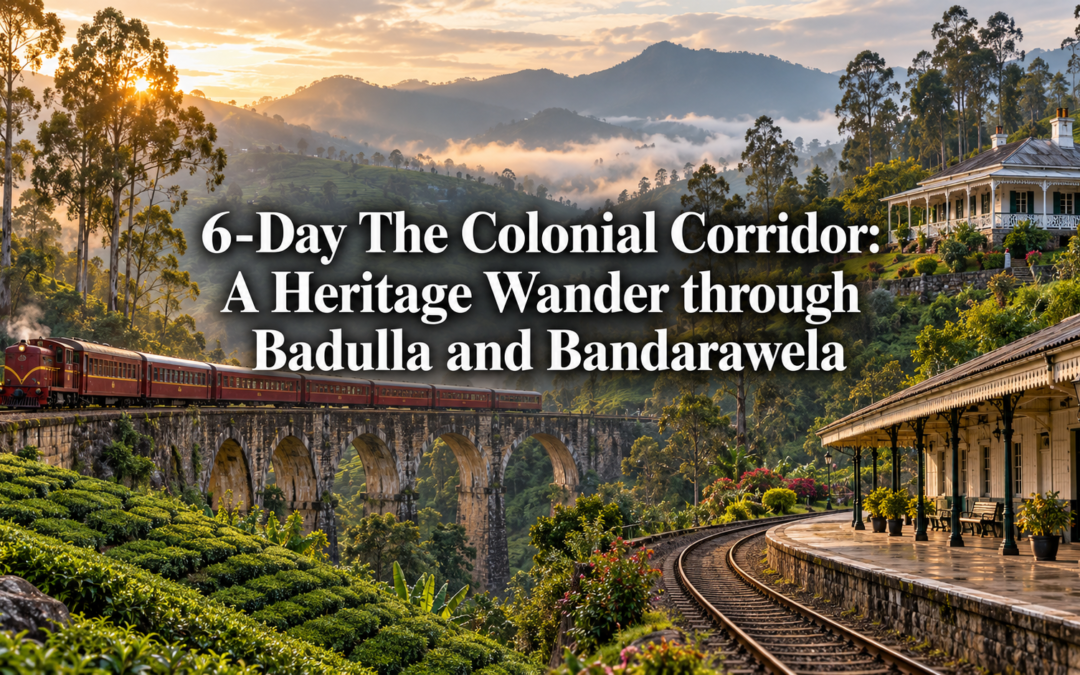
6-Day The Colonial Corridor: A Heritage Wander through Badulla and Bandarawela

6-Day The Colonial Corridor: A Heritage Wander through Badulla and Bandarawela

Everyone goes to Ella. And Ella is genuinely lovely   the famous train bridge, the viewpoints, the cafes doing a brisk trade in banana pancakes. There is nothing wrong with Ella. But there is, just beyond it, another Uva Province. One that most travellers drive through without stopping, their eyes on the road to the next listed destination, missing everything.

Badulla and Bandarawela sit a short distance east of Ella in the highland heartland of Sri Lanka. They are older, quieter, and considerably less polished. The colonial architecture here was not restored for the benefit of tourists   it is simply still standing, ageing with a kind of unhurried grace in the cool mountain air. The temples carry centuries of unbroken devotion. The railway stations were built to last, and they did. The tea estates stretch across the surrounding hills with the same careful geometry they have held for over a hundred and fifty years.

This is a route for the slow traveller. The kind of person who finds more in a quiet market street than a crowded viewpoint. The kind who wants a long breakfast on a veranda, a conversation with the guesthouse owner about the town’s history, and an afternoon with nothing scheduled except a walk and a book. Six days is the right amount of time. Possibly even slightly not enough.

Day 1 — The Train to Bandarawela

Take the train. This is important. The road from Colombo to Bandarawela works perfectly well, but the railway journey   via Kandy, Nanu Oya, and Ella   is one of the great train rides of Asia, and it would be a significant mistake to skip it in the name of efficiency.

The journey takes most of a day, depending on your starting point, but it doesn’t feel long. The landscape outside the window shifts constantly and dramatically: the low coastal plains giving way to the first hill-country foothills, the rubber estates climbing the lower slopes, and then the extraordinary ascent through the tea country   switchbacks and tunnels, viaducts over deep gorges, the air growing perceptibly cooler as the train climbs. The final approach to Bandarawela, curving through the hills in the late afternoon light, is as fine a piece of railway scenery as you will find anywhere.

Bandarawela station itself sets the tone for what follows: a solid, red-tiled building from 1894, its whitewashed walls and original wooden counter giving the impression that very little has changed since the first train pulled in. The town that spreads out from it has the same quality. Wide, unhurried streets. Old-fashioned shops. A covered market that smells of spices and dried fish. The kind of civic life that proceeds entirely on its own terms, without reference to the tourism industry.

Days 2 and 3 — Churches, Railways, and the Tea Estate Roads

Bandarawela’s colonial churches reward a morning of careful, unhurried attention. St Mark’s Church   a handsome, stone-built Anglican church dating from the late 19th century   stands on a quiet road above the town centre, its square tower visible from some distance. The building itself is well-kept and still in use, with a spare, dignified interior that speaks of the particular aesthetic sensibility of the British colonial church builder: plain walls, good light, the minimum required and no more.

The graveyard is where the history becomes tangible. The older headstones   some of them very old indeed   carry inscriptions in English, Dutch, and occasionally Portuguese, the surnames shifting across the centuries as different colonial powers moved through the island. Planters who arrived in their thirties and never left. Children who didn’t survive the first monsoon season. Administrators who had spent their entire working lives at this elevation and were buried looking out at the hills they’d managed for the Crown. There is something in the compressed weight of all that displacement that stays with you as you walk back into town.

The railway station, as mentioned, is worth more than a passing glance. Come back in the afternoon when the light is lower, sit on the platform bench, and watch the trains arrive and depart. The Udarata Menike and the Podi Menike   both legendary named services on the Colombo-Badulla line   pass through at intervals throughout the day. There is a particular pleasure in old railway stations that is very difficult to account for rationally, but very easy to feel.

On the third day, hire a tuk-tuk and spend several hours exploring the tea-estate roads above the town. The Uva tea country has a different character from the more famous estates around Nuwara Eliya   more rugged, less manicured, with wider views and far fewer visitors. The tea itself   Uva tea, with its distinctive slightly spicy, almost menthol quality   is considered among the finest produced anywhere in the world. Several estates welcome visitors for informal tastings. Ask at your hotel or guesthouse for introductions; the tea industry here is still run on relationships.

Days 4 and 5 — Badulla and the Muthiyangana Temple

Badulla is about forty minutes by road from Bandarawela, and the drive is scenic enough that it doesn’t feel like a transfer   it feels like the next part of the journey. The town sits in a broad valley ringed by hills, and has a more workaday energy than Bandarawela: a proper district capital, with a large market, a busy commercial centre, and the kind of civic infrastructure that suggests a town that has been the administrative heart of its region for a very long time. Which it has.

The centrepiece is the Muthiyangana Raja Maha Viharaya   a Buddhist temple of considerable antiquity and national importance. The site is believed, in the Sri Lankan Buddhist tradition, to have been consecrated during one of the Buddha’s three legendary visits to the island, and the Muthiyangana Dagoba at its heart is said to enshrine relics from that visit. Whether or not you hold any personal investment in that history, the temple is a genuinely affecting place to spend a morning. Pilgrims come from across the island, particularly during the annual Esala Perahera festival, when the entire town is transformed by processions of drummers, dancers, and ceremonially decorated elephants moving through the streets by torchlight.

Outside of festival season, the temple has a different quality: contemplative, industrious in its quiet way, the air thick with incense and the scent of the white temple flowers that devotees lay at the base of the dagoba throughout the day. Leave your shoes at the entrance and walk slowly around the stupa. The white dome, rising against the surrounding hills with calm, composed authority, is one of those sights that lodges itself permanently in the memory.

On your second day in Badulla, take the short five-kilometre drive north to Dunhinda Falls. The trail from the car park to the falls takes around thirty minutes through forest, and the waterfall itself   a powerful, 64-metre cascade crashing into a wide, mist-filled pool   is one of the more dramatic in the country. The walk back feels like returning from somewhere else entirely.

Day 6 — Tea Bungalows and Leaving Slowly

Use the final morning for what this entire journey has, in some sense, been building towards: a long breakfast on a tea-estate veranda, somewhere above the valley, with a clear view of the hills and the first good light coming across them.

The old colonial bungalows of the Uva Province estates were built for British planters in the 19th century and designed for exactly this kind of morning: cool air, a wide view, tea grown on the slopes directly below you. Some have been converted into guesthouses or boutique properties. Others are still working estate bungalows, rented to visitors on a night-by-night basis. All of them have the same essential quality   a sense of time moving differently, of a pace of life that was never designed to accommodate urgency.

You wake early because the mornings are cool and clear and too good to sleep through. You have your tea. You walk the estate lanes, the dew still heavy on the bushes, the pickers arriving in small groups with their baskets. You read in the afternoon. You talk to whoever sits down near you at dinner. This is, in the best possible sense, a way of travelling that has largely disappeared from the world. Six days in the Uva highlands is a good way to remember what it felt like.

Where to Stay in Badulla and Bandarawela

The region offers everything from budget guesthouses in the town centres to remarkable heritage hotels and atmospheric estate bungalows in the surrounding hills.

Bandarawela Hotel – One of Sri Lanka’s most characterful heritage hotels, open since 1894 and still carrying every bit of its colonial atmosphere. Wood-panelled corridors, a formal dining room, a library with period furniture, fireplaces in some rooms. Mid-range in price and exceptional in character – genuinely one of the most atmospheric places to stay in the hill country.

The Uva Halpewatte Tea Resort – A boutique property set within a working tea estate, offering beautifully restored bungalow-style accommodation with panoramic hillside views. Guided estate walks are available, and the sense of being embedded in a working landscape rather than merely visiting it makes a real difference.

Cressida Bungalow, Badulla – A restored colonial bungalow in the hills above Badulla, available as self-contained accommodation. Budget to mid-range depending on season. Considerably more atmospheric than any town hotel in the area, and the views from the garden are exceptional.

Sunrise Inn, Bandarawela – A clean, straightforward budget guesthouse in the centre of Bandarawela. No frills, but well located, family-run, and genuinely friendly. Ideal for travellers who want to keep costs low while remaining close to everything the town has to offer.
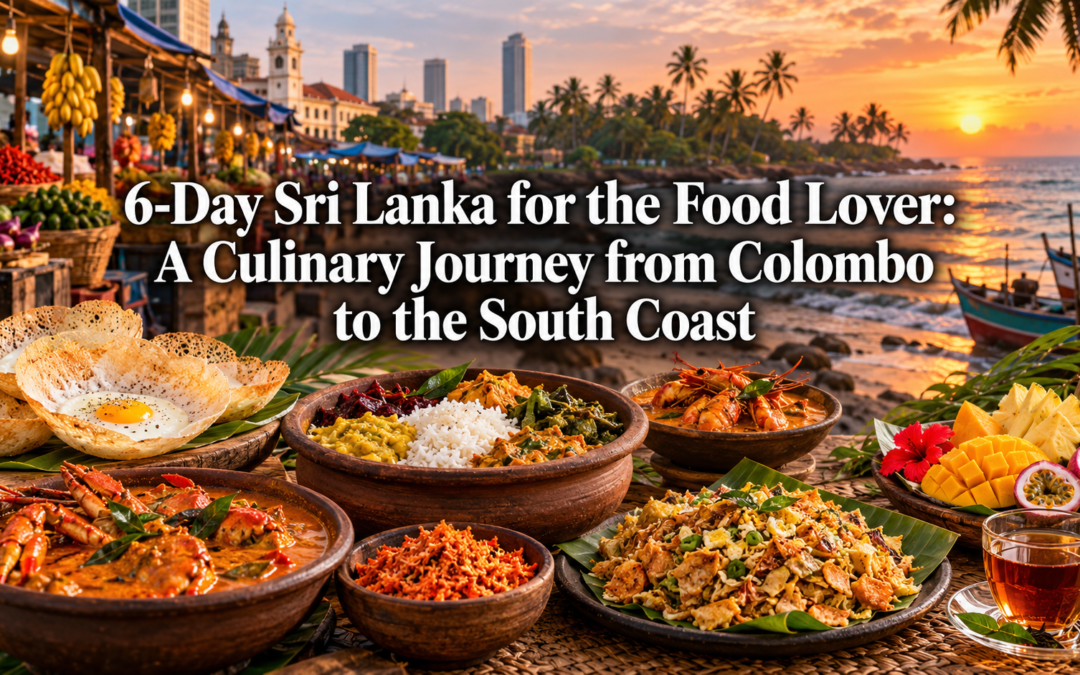
6-Day Sri Lanka for the Food Lover: A Culinary Journey from Colombo to the South Coast

6-Day Sri Lanka for the Food Lover: A Culinary Journey from Colombo to the South Coast

In 2025, Condé Nast Traveller readers ranked Sri Lanka seventh in the world for cuisine, placing it alongside France, Italy, and Thailand. That ranking surprised many people who associate Sri Lanka primarily with beaches and ancient ruins, and almost nobody who has eaten their way through the island with any seriousness. Sri Lanka has one of the most varied and genuinely delicious food cultures in Asia, and it remains one of the most underwritten food destinations in the world.

This post treats food as the primary lens for a six-day journey from Colombo to the south coast, covering the specific dishes, markets, and regional traditions that a food-motivated traveller should organise their journey around.

Understanding the Food Before You Eat

Sri Lankan food is not a single cuisine but several distinct regional traditions. The Buddhist Sinhalese tradition emphasises coconut-based curries and souring agents like goraka and tamarind. The Tamil Hindu tradition uses more pepper and less coconut, producing a spice-forward style immediately distinguishable from the Sinhalese south. The Muslim communities bring the biriyani tradition and the short eats culture of the Muslim hotel. The Burgher community contributes love cake, breudher bread, and vinegar-based preparations that arrived with the European traders and stayed.

Understanding these distinctions before you start eating changes what you notice at each meal.

Day 1 — The Colombo Street Food Circuit

Begin in the Pettah district before seven in the morning. The Muslim hotels around Main Street and Manning Market serve the best breakfast in Colombo at the lowest prices. String hoppers with coconut sambol and dhal, pol roti with seeni sambol, egg hoppers freshly made on the curved iron pan, made for the surrounding community rather than visitors, priced at between one hundred and fifty and two hundred and fifty rupees.

The Manning Market in Pettah is the largest wholesale produce market in Sri Lanka. The spice section, the dried fish vendors, the Maldive fish that forms the flavour backbone of most Sri Lankan coconut-based dishes. Maldive fish is cured tuna, dense and intensely savoury, and almost no Sri Lankan curry achieves its full depth without it. Buy a small piece and smell it. That smell is the foundation of the cuisine.

For lunch, the rice and curry restaurants behind the Pettah market serve a full meal at around two hundred to two hundred and fifty rupees. For dinner, the kottu roti makers between Wellawatte and Bambalapitiya are the correct evening option. Kottu is chopped roti worked on a hot griddle with egg, vegetables, and gravy, the chopping rhythm audible from a block away. The version at Pilawoos on Galle Road, a Colombo institution, is the benchmark.

For accommodation, Clock Inn Fort near the Fort station is clean and well-positioned for the Pettah morning visit. For mid-range comfort, Cinnamon Red on the southern end of Galle Road offers reliable rooms with good access to the Wellawatte food strip.

Day 2 — The Spice Gardens and the Road South

Drive south from Colombo toward Galle, stopping at the roadside spice operations between Colombo and Aluthgama. True Ceylon cinnamon is lighter and more complex than the cassia sold as cinnamon elsewhere in the world. Buying freshly rolled quills from a roadside seller for around three hundred rupees and smelling them beside a stick of supermarket cinnamon is one of those food education moments that permanently changes your understanding of an ingredient.

Stop at Ambalangoda for lunch. The small restaurants that use the morning fish market catch serve a grilled reef fish lunch reflecting the immediacy of the supply chain in the way that only coastal Sri Lanka can, at around three hundred to four hundred rupees.

For accommodation in Galle, Fortaleza or Fort Bazaar inside the fort offer boutique mid-range rooms. For dinner, Pedlar’s Inn Cafe uses local ingredients with genuine care, the menu changing with what the surrounding markets produce.

Day 3 — The Galle Food Market and the Fort Kitchen

The Galle main market outside the fort walls operates from early morning. Arrive before eight. The vegetable section reflects the mixed agricultural economy of the southern province, highland vegetables alongside coastal smallholding produce. The spice section carries pepper, cloves, and vanilla grown in plots that have been in the same family for generations.

A cooking class through one of the independent Galle food teachers, covering the tempering of mustard seeds in coconut oil, building a coconut milk curry from scratch, and the correct ratio of Maldive fish to pol sambol, teaches you more about Sri Lankan food in one session than a week of eating in restaurants. Cost runs at around four thousand to six thousand rupees per person.

For lunch, the government-run Raja Bojun restaurant near the Galle bus station serves a full rice and curry for around two hundred and fifty rupees, the most honest introduction to the Sri Lankan lunch plate available in the city.

Day 4 — The Southern Fishing Villages and the Seafood Economy

Drive east from Galle toward Tangalle, stopping at fishing village beaches where the boats come in between six and eight. The informal fish sales on the sand as the catch arrives give you a direct encounter with the supply chain that ends on restaurant plates along this coast.

The best way to eat the southern coast seafood is the simplest: a beachside restaurant in Mirissa or Tangalle that grills the morning catch over charcoal with rice and coconut sambol and a lime. Look for establishments where the fishing community itself eats rather than the ones with English menus displayed outside.

For accommodation near Tangalle, Buckingham Place on its own beachfront stretch offers mid-range comfort with a kitchen that sources locally. For a budget option, the small guesthouses along the Tangalle lagoon road offer clean rooms at around two thousand rupees with home-cooked meals that reflect the southern Sri Lankan domestic kitchen more honestly than most restaurants.

Day 5 — The Hill Country Food Culture

Drive north into the hill country and the food changes completely. The highland kitchen reflects a cooler climate, the leeks and carrots and potatoes of the high-altitude gardens replacing the tropical produce of the coast with an immediacy visible in roadside stalls as the elevation increases.

The jaggery and treacle culture of the hill country deserves specific attention. Kithul jaggery, made from the sap of the kithul palm, has a deep complex sweetness entirely different from cane sugar, and the combination of buffalo curd and kithul treacle is one of the most underrated food experiences on the island. The curd, set in clay pots with a slightly sour edge, costs around two hundred rupees and is available in every guesthouse with enough local clientele to bother making it properly.

For accommodation in Ella, 98 Acres Resort handles the mid-range option with good views and a kitchen that draws on the surrounding hill country produce. For budget, the guesthouses along the main street offer clean rooms and home cooking at its most honest.

Day 6 — The Muslim Food Tradition and the Return

Use the final day to explore Sri Lanka’s Muslim food tradition before the return to Colombo. Found across the island but at its most developed in the western coastal towns and Colombo’s Maradana district, it represents one of the most distinctive and least written-about strands of Sri Lankan food culture.

The biriyani here is the working day version, cooked in large pots from before dawn and served from midday until it runs out, usually by two in the afternoon. The meat is cooked into the rice, the spice blend reflecting the trade route history of the communities that developed the dish on this island, at around three hundred to four hundred rupees for a generous portion.

The short eats culture, fish cutlets and meat rolls and Chinese rolls and vadai filling the glass-fronted display cases from early morning, is the island’s most democratic food tradition. Eating through the display case of a good Muslim hotel short eats counter is the most efficient introduction to Sri Lankan snack food culture available.

Practical Notes

The best time for the southern coast seafood is between November and April when the fishing season is at its most productive. The Galle market is at its most varied between Tuesday and Saturday. Cooking class bookings in Galle should be made at least two days in advance. Carry cash for market visits and the street food circuit, as most establishments that produce the best food on this journey do not accept cards. Eating where the surrounding community eats rather than where the English menu is displayed outside remains the single most reliable guide to quality across the entire journey.

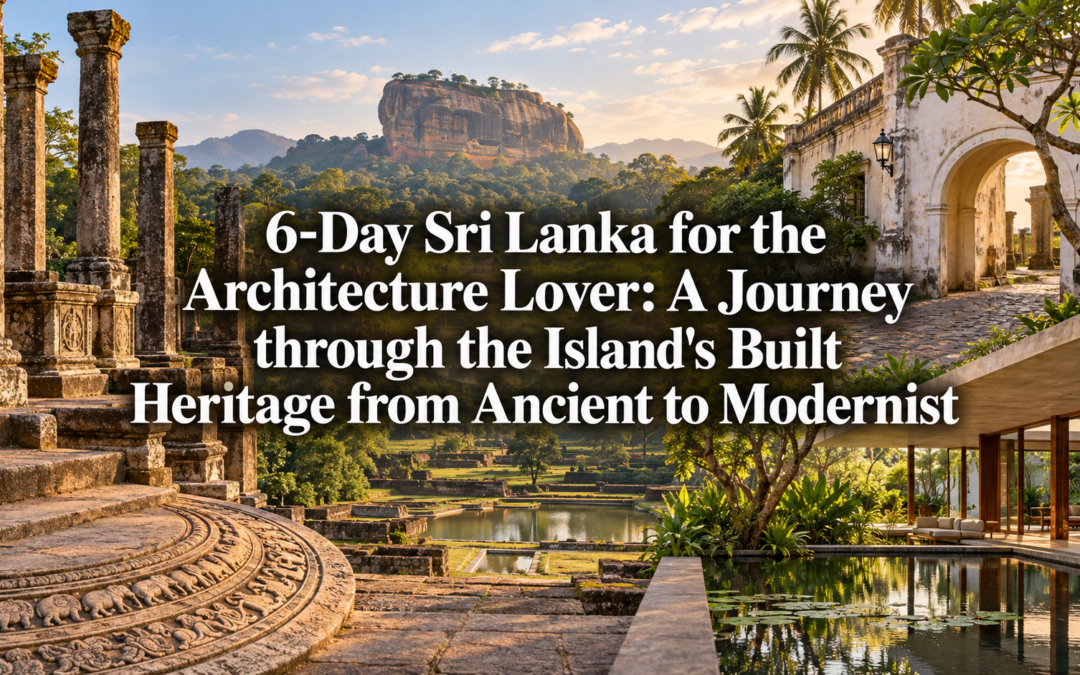
6-Day Sri Lanka for the Architecture Lover: A Journey through the Island’s Built Heritage from Ancient to Modernist

6-Day Sri Lanka for the Architecture Lover: A Journey through the Island’s Built Heritage from Ancient to Modernist

Most travel writing treats Sri Lanka’s buildings as backdrops to a wildlife encounter or a beach holiday, mentioned in passing rather than examined as the primary subject. This is a mistake. Sri Lanka’s architectural record runs from prehistoric cave modification through engineering feats that predated their European equivalents by a millennium, through Portuguese fortification and Dutch commercial design and British civic ambition, arriving finally at a twentieth-century modernist tradition, led by Geoffrey Bawa, that absorbed every preceding layer and produced something genuinely new. This is a journey for the traveller who reads buildings the way other people read landscapes.

Six days moves roughly in chronological order, from the engineering logic of the ancient dagoba to the tropical modernism that closed the twentieth century, with each day building the vocabulary needed to understand the next.

Day 1 — Colombo and the Bawa Foundation

Begin at Number 11, Geoffrey Bawa’s own house on 33rd Lane in Colombo, the single best introduction to the architect whose work anchors the final chapters of this journey. Bawa spent decades assembling four adjoining bungalows into a single dwelling of shifting courtyards, borrowed light, and deliberately withheld views, a building that teaches the visual grammar, deep verandas, internal courtyards, the constant negotiation between inside and outside, that recurs throughout the tropical modernist buildings you will visit later in the week. Book a guided tour in advance through the Geoffrey Bawa Trust; walk-ins are not accepted.

In the afternoon, walk the Fort district to see Colombo’s British civic architecture, the Old Parliament Building, the Cargills and Millers department store facades, and the clock tower, all built between the 1860s and 1930s in a colonial style that mixed British institutional confidence with tropical adaptations, deep colonnades and high ceilings designed for a climate the architects were still learning to build for. For dinner, Ministry of Crab near the Old Dutch Hospital occupies a beautifully restored 17th-century Dutch colonial building, itself worth the visit independent of the food. For accommodation, Cinnamon Red on Galle Road offers a well-located, comfortable base for the Colombo portion of the trip.

Day 2 — Anuradhapura and the Engineering of the Dagoba

Drive north to Anuradhapura to study the ancient dagoba as a feat of structural engineering rather than simply a devotional monument. The Jetavanaramaya, at its original height comparable to a forty-storey building, was constructed almost entirely of fired brick, an estimated ninety million of them, using a solid stepped-pyramid core and a lime plaster rendering technique that allowed a structure of this mass to stand without the internal chambers that later architectural traditions relied on for stability.

Spend the afternoon comparing the structural approaches of the Ruwanwelisaya and Abhayagiri dagobas, each reflecting subtle engineering refinements across the centuries of their construction and repair. The Vatadage, a circular relic house with concentric rings of stone columns that likely once supported a wooden roof structure, shows a completely different structural logic, timber and post rather than solid mass, and is worth studying specifically for the contrast. For accommodation, Ulagalla Resort on the city outskirts offers comfortable rooms within a converted chena estate, its own architecture drawing consciously on the vernacular building traditions of the surrounding region.

Day 3 — Polonnaruwa and Yapahuwa: Medieval Ambition

Drive to Polonnaruwa, where the architectural language shifts from the ancient dagoba tradition to a medieval palace and shrine complex of considerable ambition. The Royal Palace of Parakramabahu I, originally seven storeys according to historical accounts, survives now only at its lower levels but the thickness of the surviving brick walls gives a clear sense of the structure’s original scale. The Quadrangle nearby is the more rewarding architectural site, a compact cluster of shrines built within a single generation and showing a coherence of design across the Vatadage, the Hatadage, and the Satmahal Prasada, a stepped pyramid form unlike anything else on the island.

In the afternoon, continue to Yapahuwa, the 13th-century rock fortress whose ornamental stone staircase is the finest surviving example of medieval Sinhalese decorative stonework, its lion-flanked balustrades and elaborately carved makara arches reflecting South Indian architectural influence absorbed and reworked into a distinctly Sinhalese idiom. For accommodation, return toward Kurunegala, where Diya Dahara Resort offers comfortable mid-range rooms.

Day 4 — Galle and the Dutch Commercial City

Drive to Galle to study the most complete surviving example of Dutch colonial urban design in Asia. The fort, substantially rebuilt by the Dutch after 1640, reflects a specifically commercial architectural logic, thick-walled warehouses built to withstand the tropical climate and protect valuable cinnamon stock, a grid street plan designed for efficient movement of goods, and residential buildings combining Dutch gable ends with deep verandas borrowed from the Portuguese and adapted further for the climate.

Walk the warehouse quarter near the old harbour, where the surviving Dutch commercial buildings, now largely converted to boutique hotels and shops, retain their original thick coral-stone walls and small, deliberately restricted window openings. The Groote Kerk, built in 1755, uses a floor paved with Dutch colonial tombstones and a roof structure of considerable engineering ambition for its period. For accommodation, Fort Bazaar inside the fort walls occupies a restored historic structure and offers the most immersive architectural experience available in Galle. For dinner, Pedlar’s Inn Cafe operates from within another beautifully preserved fort building.

Day 5 — Lunuganga and the Birth of Tropical Modernism

Drive to Bentota to visit Lunuganga, Geoffrey Bawa’s country estate and the laboratory where he developed the ideas that would define his mature architectural language over five decades of continuous modification. Unlike Number 11’s urban compression, Lunuganga is about landscape, terraced gardens, borrowed views across the lake, and a series of pavilions and follies positioned to frame specific vistas, a building and garden so thoroughly integrated that separating the architecture from the landscape design becomes impossible and, ultimately, beside the point.

A guided tour, arranged in advance, is essential to understanding the property’s evolution across the decades Bawa spent reworking it. The visit clarifies what distinguishes Bawa’s tropical modernism from the international modernist movement he trained within in Britain: a rejection of the glass box in favour of buildings that dissolve their boundaries with the surrounding landscape entirely. For accommodation nearby, Villa Bentota, itself a Bawa-influenced property, offers a comfortable base with genuine architectural interest of its own.

Day 6 — Nuwara Eliya and the Colonial Hill Station

Drive into the hill country to Nuwara Eliya, the clearest surviving example of British colonial civic ambition on the island. Built from the 1880s onward as a deliberate recreation of an English hill station, the town’s mock-Tudor architecture, the Grand Hotel, the Hill Club, and the racecourse and golf course buildings, represents an entirely different colonial architectural project from Galle’s commercial Dutch pragmatism, aspirational rather than functional, designed to reproduce a specific idea of England in the tropics rather than to solve a local problem.

Walk the town centre in the late morning to see the post office, the town hall, and the surrounding residential bungalows, their steep gabled roofs and brick chimneys entirely unsuited to the tropical climate and built anyway, out of a kind of architectural homesickness that Bawa’s later work would consciously and deliberately reject. The contrast with everything seen over the preceding five days, ancient engineering solving genuine structural problems, medieval architecture as ceremonial statement, Dutch pragmatism, and finally British aspiration answered by Bawa’s late-century synthesis, closes the architectural argument the week has been building. The drive back to Colombo takes around five hours.

Practical Notes

Book the Number 11 and Lunuganga tours through the Geoffrey Bawa Trust website at least a week in advance, as both operate on a fixed guided-tour schedule with no walk-in access. The best months for this route are January through April, avoiding both monsoon seasons. Guides at Anuradhapura and Polonnaruwa are best arranged the evening before through your accommodation. Modest dress covering shoulders and knees is required at all religious sites. Carry cash, as ATM access outside the larger towns on this route is limited.

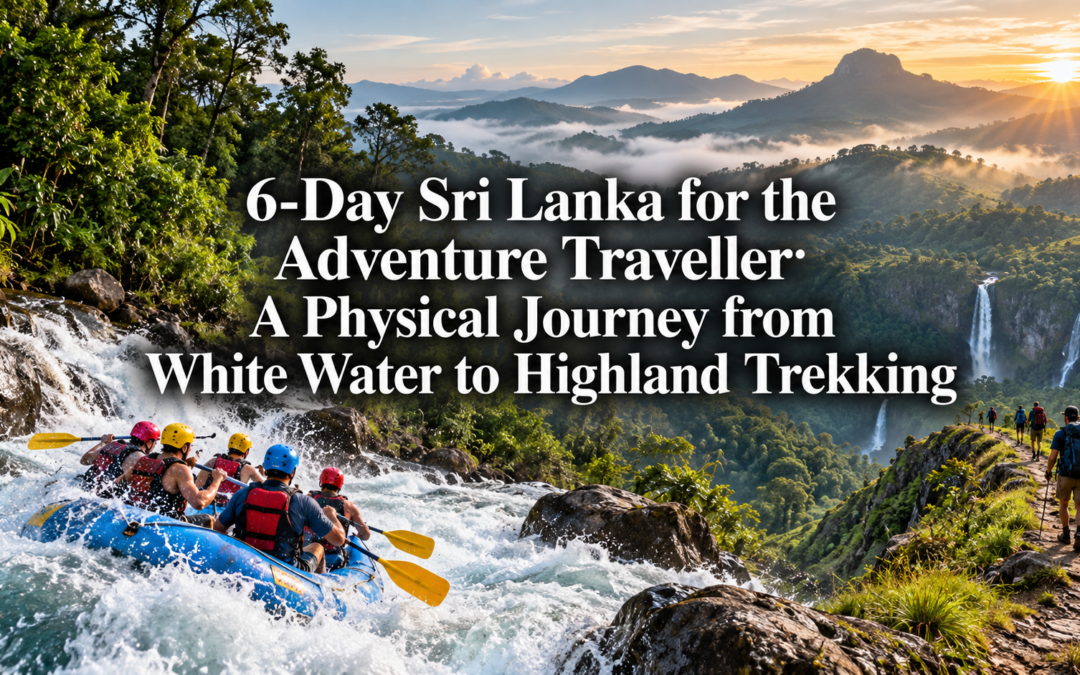
6-Day Sri Lanka for the Adventure Traveller: A Physical Journey from White Water to Highland Trekking

6-Day Sri Lanka for the Adventure Traveller: A Physical Journey from White Water to Highland Trekking

Sri Lanka’s adventure tourism offering is considerably more developed than the island’s mainstream reputation suggests, a genuine white-water river, a surf coast with a world-class point break, a kitesurfing lagoon rated among the best in Asia, and a highland trekking network that rivals anything in the region for scenery if not scale. Most of what gets written about it is marketing copy rather than an honest account of difficulty, season, and what an activity actually costs and requires, and the gap between the brochure description and the reality on the ground is where injuries and disappointments both tend to happen. This is the honest version, with ratings that assume no prior experience and no exaggerated fitness.

One geographic reality needs stating upfront: Arugam Bay on the east coast and Kalpitiya on the northwest coast run on opposite monsoon calendars and sit on opposite sides of the island, and no six-day trip can responsibly visit both at their best. This route covers the central and southern activities in sequence, then offers two alternate closing days, surf or kite, chosen according to the season you are travelling in.

Day 1 — White Water on the Kelani River

Begin at Kitulgala, about three hours from Colombo, home to the only commercial white-water rafting on the island. The Kelani River here runs a stretch of grade two to three rapids, genuinely exciting for a first-timer without tipping into the technical territory that requires prior experience. A half-day trip, arranged through an established operator such as Borderlands or Rafters Retreat, costs around five thousand to seven thousand rupees per person and includes safety briefing, equipment, and a qualified river guide.

Honest difficulty rating: moderate, suitable for reasonably fit beginners with no rafting experience, not recommended for non-swimmers or children under ten. The best water levels run from May through November, after the south-west monsoon has filled the catchment; outside this window the rapids can run disappointingly low. For accommodation, Rafters Retreat on the riverbank offers simple rooms and puts you within walking distance of the put-in point for an early morning start.

Day 2 and 3 — The Peak Wilderness Overnight Trek

Drive to Nallathanniya, the starting point for treks into the Peak Wilderness Sanctuary surrounding Adam’s Peak, and spend two days on a route considerably less crowded and more physically demanding than the standard pilgrim ascent. Rather than the paved pilgrim stairway, arrange a guided overnight trek through the forest reserve itself with an operator such as Eco Team, camping within the sanctuary boundary before a dawn approach to the summit from a less-travelled direction.

Honest difficulty rating: challenging, involving a full day of forest walking with genuine elevation gain, an overnight camp with basic facilities, and a pre-dawn summit push in cold, often wet conditions. A reasonable level of hiking fitness is required; this is not the tourist-friendly pilgrim stairway climbed in sandals, and several sections involve scrambling over exposed roots and loose rock that a casual walker will find genuinely tiring. The best season is December through April, outside the monsoon and during the traditional pilgrimage season, though this also means sharing the summit itself with pilgrims regardless of your approach route. Camping equipment is provided by the operator; personal cold-weather layers are essential, as the summit temperature at dawn regularly drops below ten degrees, considerably colder than most visitors expect from a tropical island.

Day 4 — The Pekoe Trail Above Haputale

Drive to Haputale, around three hours, to walk one of the ridge sections of the Pekoe Trail, the long-distance hiking route that links the hill country’s tea estate paths into a single continuous network. The stages above Haputale offer some of the most dramatic ridge walking on the trail, exposed sections with views dropping directly to the southern lowlands on clear days, a genuinely different physical register from the forest trekking of the previous two days.

Honest difficulty rating: moderate, a full day’s walking on established estate paths and ridge tracks rather than technical terrain, accessible to a reasonably fit hiker without specialist equipment. The trail is walkable year-round, though January through April offers the clearest visibility for the ridge views the route is known for. For accommodation, a small guesthouse in Haputale town offers simple, clean rooms and the kind of early breakfast a dawn trail start requires.

Day 5 — Rekawa and the Southern Coast

Drive south to the Rekawa area on the southern coast, around four hours, for an afternoon of cliff diving at the rock formations along this stretch of coastline. This is genuinely informal activity rather than a commercially operated one; local guides who know the specific rock platforms, tide conditions, and water depth are essential rather than optional, and arranging one through your accommodation is a safety requirement, not a suggestion.

Honest difficulty rating: variable and genuinely dependent on tide and swell conditions on the day, ranging from modest jumps suitable for a confident swimmer to more serious drops that should only be attempted with direct local guidance confirming water depth. Do not attempt this without a guide who has checked the specific platform that day. The safest window is during calm sea conditions between December and April. For accommodation nearby, Buckingham Place on the Tangalle coast offers a comfortable base for the night.

Day 6 — The Two Endings

Where you finish depends on when you are travelling. Between May and September, drive or fly to Arugam Bay on the east coast for the point break that has made it one of the most respected surf destinations in Asia, a long right-hander offering rides of genuine length for an intermediate or advanced surfer, with board hire and lessons widely available through operators along Main Street. Honest difficulty rating: the main point break suits intermediate and advanced surfers; beginners should stick to the gentler breaks closer to the village centre.

Between December and April, head instead to Kalpitiya on the northwest coast, where the Puttalam Lagoon offers flat, consistent wind conditions rated among the best kitesurfing water in Asia, with established schools such as Kite Club Kalpitiya offering lessons, certification, and equipment hire for beginners through advanced riders. Honest difficulty rating: the lagoon’s shallow, flat water makes it genuinely one of the more forgiving learning environments anywhere, though the open sea sections require considerably more experience.

Practical Notes

Book rafting and trekking operators at least several days in advance during peak season, particularly for the Peak Wilderness overnight trek, which requires camping permits arranged ahead of time and cannot reliably be booked on short notice once the pilgrimage season is underway. Travel insurance covering adventure activities specifically, rather than a standard policy that excludes them in the fine print, is strongly advisable given the genuine physical risk involved in several of these days. Carry cash throughout, as most local guides and smaller operators outside the main tourist towns do not accept cards, and mobile signal in the Peak Wilderness and along the Pekoe Trail ridge sections is unreliable enough that a paper confirmation from your operator is worth having. Respect every honest difficulty rating given here; the rescue infrastructure supporting these activities is considerably less developed than in more established adventure destinations, and the margin for error is correspondingly smaller.

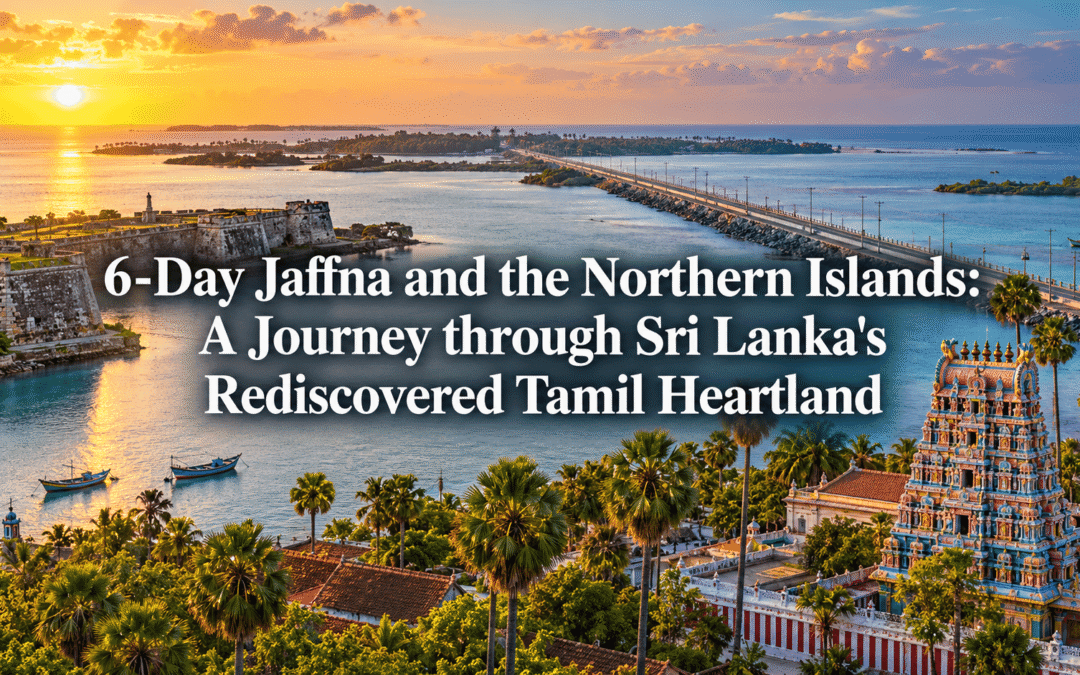
6-Day Jaffna and the Northern Islands: A Journey through Sri Lanka’s Rediscovered Tamil Heartland

6-Day Jaffna and the Northern Islands: A Journey through Sri Lanka’s Rediscovered Tamil Heartland

For most of the past forty years, Jaffna was absent from the Sri Lankan travel map entirely, the civil war that centred on the north making the peninsula inaccessible to visitors for a generation. What reopened when the conflict ended in 2009 was an almost unchanged world, a Tamil cultural heartland that had continued developing its own distinct character for two thousand years with minimal outside interruption. Lonely Planet named Jaffna one of its top global destinations for 2026, and improved rail and road connections have made a region that felt genuinely remote as recently as a decade ago into a straightforward six-hour journey from Colombo. Most travel content still treats it as a footnote. This is an argument for treating it as a destination in its own right.

Six days here covers the city itself, the causeway islands with their wild ponies and Dutch ruins, the palmyra palm economy that shapes the northern landscape, and a food tradition, crab curry, odiyal kool, that remains one of the least written-about regional cuisines in Sri Lanka.

Day 1 — Arriving in Jaffna

Take the morning train from Colombo, about six hours through the dry zone interior and the increasingly flat, palmyra-studded landscape of the north, a journey considerably more comfortable and scenic than the equivalent road trip. Arrive in the early afternoon and check into your accommodation before walking Jaffna Fort, built originally by the Portuguese in 1618 and substantially rebuilt by the Dutch, its star-shaped ramparts among the largest Dutch fortifications outside Europe and, unlike Galle, walked by almost nobody.

The fort suffered significant damage during the war and its restoration remains a work in progress, giving it an atmosphere considerably rawer and less curated than the polished heritage tourism of the south. Walk the ramparts in the late afternoon light and note the layered construction, Portuguese foundations, Dutch reinforcement, colonial-era additions, visible in the brickwork if you look closely. For accommodation, Jetwing Jaffna in the town centre offers the most comfortable base for the week. For dinner, Mangos Restaurant serves a reliable introduction to northern Tamil cooking, considerably more pepper-forward than the coconut-based cuisine of the south.

Day 2 — The Nallur Kandaswamy Kovil and the City

Spend the morning at Nallur Kandaswamy Kovil, the most important Hindu temple in Sri Lanka and the spiritual centre of Tamil religious life on the island. The current structure dates from the 20th century, the original temple destroyed by the Portuguese in the 17th century, but the site’s sacred history extends back considerably further, and the temple’s daily rituals, conducted with a formality and intensity that rewards quiet, respectful observation, offer a direct encounter with a living devotional tradition rather than a heritage site.

If your visit coincides with the Nallur Festival in August, a twenty-five day procession culminating in a dramatic chariot ceremony, reorganise the itinerary around it; the scale and intensity of the celebration is unmatched anywhere else on the island. Spend the afternoon walking the town centre, the restored Jaffna Public Library, itself a symbol of the city’s cultural resilience after its destruction and subsequent rebuilding, and the market streets where the palmyra-based economy of the region is visible in every stall. For lunch, the small vegetarian restaurants near the temple serve a thali-style meal reflecting the strict dietary practices of temple-going Hindu families in the area.

Day 3 — Delft Island

Take the morning ferry from Kurikadduwan to Delft Island, about an hour across calm lagoon water, for a landscape unlike anywhere else in Sri Lanka. Delft’s dry, windswept terrain, criss-crossed with coral-stone fences built by Dutch colonists in the 17th century, supports a population of wild ponies descended from horses the Dutch introduced for breeding, animals that now roam the island’s scrubland with genuine, unmanaged freedom.

The Dutch fort ruins on the island’s northern edge, along with a colonial-era pigeon coop and a baobab tree believed to have arrived with Arab traders centuries before European contact, give Delft a layered, slightly haunted quality that rewards a full day of unhurried exploration. Hire a bicycle at the jetty, the flat terrain making it the correct way to cover the island’s modest distances. Return on the afternoon ferry and have dinner back in Jaffna at Cosy Restaurant, known locally for its crab curry, made with the lagoon crab that defines the northern coastal cuisine.

Day 4 — Nainativu and the Shared Sacred Island

Take the ferry to Nainativu, known in Tamil as Nagadeepa, a small island holding both a significant Hindu temple, the Nagapooshani Amman Kovil, and a Buddhist temple, the Nagadeepa Vihara, within a short walk of each other, a physical proximity that reflects the island’s status in both Hindu and Buddhist tradition as a site of ancient sacred significance. The coexistence of the two temples, visited by pilgrims of both faiths without apparent tension, offers a quiet counterpoint to the narrative of purely divided communities that outside accounts of the north sometimes assume.

Spend the late morning walking the island’s quiet lanes before returning to Jaffna for the afternoon. Visit the Jaffna Archaeological Museum, modest but genuinely informative on the peninsula’s pre-colonial Tamil kingdom history, a period considerably less documented in the standard Sri Lankan historical narrative than the Sinhalese Buddhist kingdoms of the south. For dinner, return to the market area for a simple, informal meal of short eats from one of the Tamil hotels near the bus stand.

Day 5 — The Palmyra Economy and the Rural North

Spend the day driving the rural roads north and east of Jaffna town, where the palmyra palm, tolerant of the region’s saline soil and limited rainfall in a way few other crops are, defines both the landscape and the local economy in a manner unmatched anywhere else in Sri Lanka. Visit a jaggery and palm syrup producer, where the sap is collected daily by climbers using traditional techniques passed through generations, and boiled down into the dense, distinctively flavoured jaggery that anchors much of the north’s traditional confectionery.

The palmyra leaf itself is worked into baskets, mats, and roofing material by artisans whose techniques have changed little over centuries, and a visit to a small workshop, arranged through your accommodation, gives a direct sense of a functioning craft economy rather than a demonstration staged for visitors. For lunch, a rural roadside kade serving palmyra-root curry and rice offers a specifically northern dish rarely found outside the region. For dinner back in Jaffna, try odiyal kool, a distinctive seafood and palmyra-flour porridge unique to the peninsula, at one of the small family-run establishments near the fort.

Day 6 — Casuarina Beach and the Return

Use the final morning for Casuarina Beach on the Karainagar peninsula, a shallow, calm stretch of sand backed by casuarina trees and almost entirely undeveloped, a striking contrast to the commercialised beaches of the south and west coasts. The water here is unusually shallow for a considerable distance from shore, making it one of the safer swimming beaches on the island and, on a weekday morning, frequently empty.

Depart Jaffna in the early afternoon for the train back to Colombo, the six-hour journey giving ample time to process a week spent in a part of Sri Lanka that most visitors, even repeat ones, have never seen.

Practical Notes

The best months for this route are January through September, avoiding the north-east monsoon that affects the region between October and December. The Nallur Festival in August is worth planning a visit around specifically if the dates align. Ferries to Delft and Nainativu operate on a fixed schedule from Kurikadduwan, roughly forty-five minutes by road from Jaffna town, and should be checked in advance through your accommodation. Modest dress is expected at all temple sites. Carry cash throughout, as card acceptance outside Jaffna town itself remains limited.

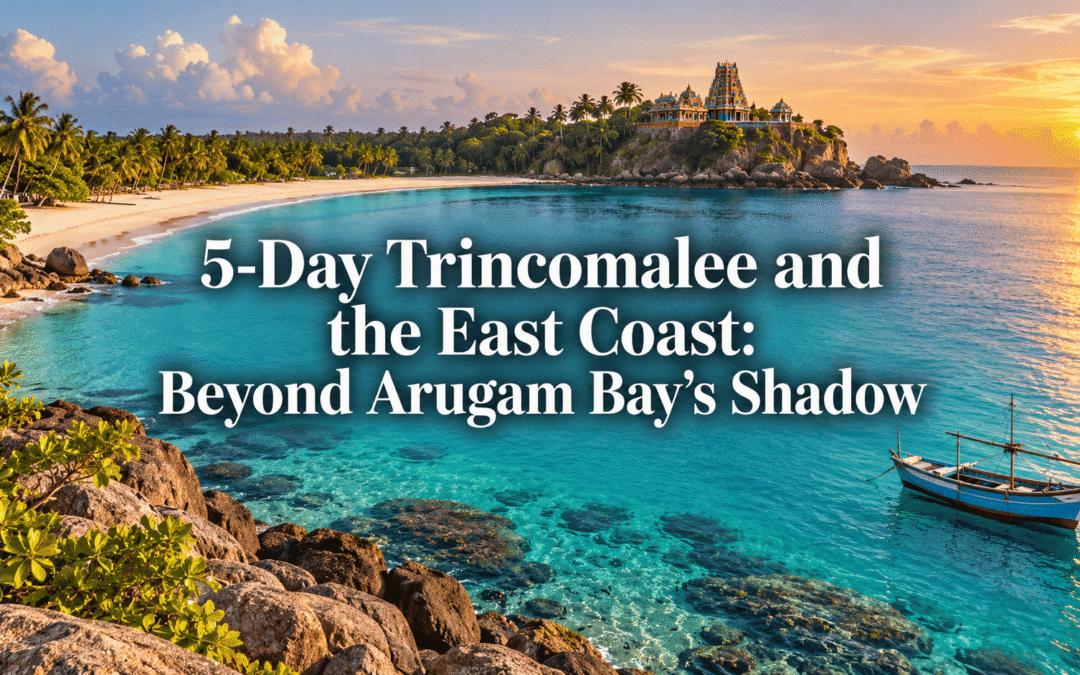
5-Day Trincomalee and the East Coast: Beyond Arugam Bay’s Shadow

5-Day Trincomalee and the East Coast: Beyond Arugam Bay’s Shadow

Arugam Bay has absorbed most of the attention paid to Sri Lanka’s east coast, its point break turning a small fishing village into a fixture of the international surf circuit and, in the process, drawing most of the available travel writing along with it. Trincomalee, roughly two hundred kilometres north, has been left comparatively undocumented despite offering one of the finest natural harbours in Asia, some of the best diving and snorkelling in South Asia at Pigeon Island, genuine WWII naval history, and a seasonal whale watching season that rivals anything the south coast produces. This is the case for going north instead.

Five days here covers the bay’s colonial and wartime layers, the coral reefs of Pigeon Island National Park, the region’s whale watching season, and the quieter beach towns of Uppuveli and Nilaveli, a different register entirely from the surf-driven economy further south.

Day 1 — Arriving in Trincomalee

Trincomalee’s harbour, one of the largest natural deep-water harbours in the world, has made the town strategically significant for over two thousand years, fought over by South Indian kingdoms, the Portuguese, the Dutch, the British, and, during the Second World War, defended by the Royal Navy as a critical Allied base in the Indian Ocean theatre. Arrive in the early afternoon and walk up to Fort Frederick, built originally by the Portuguese in 1623 and expanded by the Dutch and British, its ramparts giving the clearest vantage point over the harbour’s scale.

Within the fort grounds, Koneswaram Kovil sits at the cliff edge on Swami Rock, one of the most sacred Hindu sites on the island and a temple whose current structure dates from the 20th century after the original, destroyed by the Portuguese in 1622, was never fully rebuilt on its original scale. The view from the temple platform, the cliff dropping directly to the sea below, is among the more dramatic sacred sites anywhere in Sri Lanka. For accommodation, Jungle Beach by Uga Escapes offers a genuinely well-designed base a short drive from the town centre. For dinner, the hotel’s restaurant handles fresh-caught seafood with more care than most establishments in Trincomalee town itself.

Day 2 — Pigeon Island and the Coral Reefs

Drive to Nilaveli in the morning and take a short boat crossing to Pigeon Island National Park, named for the rock pigeons that inhabit its rocky outcrops and, more importantly, home to one of the most accessible and rewarding coral reef systems in South Asia. The shallow water around the island supports over a hundred species of coral and several hundred species of tropical fish, and the snorkelling here, requiring no diving certification and manageable by a reasonably confident swimmer of almost any age, is genuinely comparable to destinations that charge considerably more and require considerably more planning.

Arrange a half-day snorkelling trip through one of the established operators in Nilaveli, such as Poseidon Diving Station, at around six thousand to eight thousand rupees including equipment, park entrance fees, and boat transport. Certified divers can arrange a more extensive reef dive through the same operators, with reef sharks, turtles, and occasional ray sightings a realistic possibility beyond the standard snorkelling circuit. For lunch, a simple beachfront restaurant in Nilaveli serving the morning’s catch is the correct choice after a morning in the water. For accommodation, remain at Jungle Beach or consider Pigeon Island Beach Resort directly in Nilaveli for easier access to the following morning’s boat departure.

Day 3 — Whale Watching in Trincomalee Bay

Trincomalee’s whale watching season, running from roughly May through October, coincides with blue and sperm whale migration through the deep water immediately offshore, a season that runs opposite to the south coast’s Mirissa season and offers a genuine alternative for travellers visiting outside the traditional December to April high season. The proximity of deep water to the coast here means boat trips can reach whale territory considerably faster than the equivalent Mirissa excursions, often within thirty to forty minutes rather than the two-hour approach common in the south.

Book a morning trip through an established operator, departing before seven to catch the calmest sea conditions and the highest probability of a sighting. Sightings are not guaranteed on any single trip, and an honest operator will say so rather than promising certainty. For the remainder of the day, use the afternoon for Marble Beach, a quieter, less developed stretch of coastline within the naval base area requiring advance permission to access, arranged through your accommodation, and rewarding the extra step with clear water and minimal crowds. For dinner, return to Nilaveli for another straightforward seafood meal at one of the beach road establishments.

Day 4 — Kanniya Hot Springs and the Beach Towns

Visit Kanniya Hot Springs in the morning, a set of seven wells within a compact temple complex a short drive from Trincomalee town, each well maintaining a distinct temperature according to local tradition, a detail visitors are invited to test for themselves by drawing water and pouring it over their heads in the traditional manner. The springs’ origin is attributed in local legend to the Ramayana, giving the site a devotional significance beyond its geological curiosity.

Spend the remainder of the day moving between Uppuveli and Nilaveli, the two beach towns anchoring Trincomalee’s tourism economy, each considerably smaller and less developed than the equivalent towns on the south and west coasts. Uppuveli’s beach, closer to town, suits an afternoon of straightforward swimming and rest, while Nilaveli further north offers a longer, quieter stretch of sand. For dinner, Anchor Restaurant in Uppuveli serves a reliable seafood platter and stays open later than most establishments in the area, useful after a full day of moving between sites.

Day 5 — The Harbour and the Return

Use the final morning for a slow walk or boat trip around the inner harbour, where the scale of Trincomalee’s natural asset becomes fully apparent, a body of water large enough to have anchored entire wartime fleets and quiet enough, on an ordinary Tuesday morning, to hold nothing more than a handful of local fishing boats. The contrast between the harbour’s historical and strategic importance and its current, comparatively undeveloped tourism footprint is the clearest single argument for visiting Trincomalee now rather than waiting for the rest of the travel industry to catch up.

The drive back to Colombo takes around five to six hours depending on the route, or a considerably faster domestic flight is available from China Bay Airport for travellers short on time. Either way, the journey back gives time to register a stretch of coastline that, for now, still rewards the traveller willing to look past Arugam Bay’s gravitational pull.

Practical Notes

The best months for this route are May through September for whale watching and the calmest sea conditions, though Pigeon Island snorkelling is enjoyable outside this window as well, avoiding only the north-east monsoon period between November and January. Book Pigeon Island trips and whale watching excursions the evening before through your accommodation rather than expecting availability on the day. Access to Marble Beach requires advance permission due to its location within the naval base area. Carry cash throughout, as card acceptance outside the main hotels remains inconsistent.